Showing posts with label picture books about creativity. Show all posts

Friday, September 9, 2022

MAGGIE’S TREASURE by Jon-Erik Lappano & Kellen Hatanaka - a book about treasure collecting and community

Girl pulling a wagon loaded with small treasures

Why this book?

My students are always finding all kinds of treasures, so I know they will love this book! I especially connected with the idea of noticing the small or unused things in the world and thinking about how they could be used or re-used. The illustrations are bold and colourful with a fun, distinctive style. 

My thoughts as a creator:

There are some lovely phrases in this story. One of my favourites is, “Maggie saw the sparkle in everything.” A nice book to study when thinking about using your observations of the world to add details to a story.

My thoughts as an educator:

The theme of helping the community is always great to promote activism and encourage students to create their own projects!  It would be interesting to discuss the main ideas in this story in comparison with the picture book Maybe Something Beautiful by F. Isabel Campoy and Theresa Howell with illustrations by Rafael Lopez.

Ages: 4 - 7

Grades: K - 3

Connections: re-using materials, collections, helping the community

Activities:

Active Play & Math – Go on a hunt outside (or inside) to find treasures. Encourage children to sort their “treasures” in different ways. Listen as they explain their reasoning for how they sorted them.

Building Community: What might happen if everyone in the class brought one toy or book they didn’t want any more? Could they be given to others or exchanged with each other?

Community Art Project: Encourage everyone in the class to bring in one “treasure” to glue onto a large board or canvas to create a class art project to display in the classroom.

Create – Give children a small collection of “treasures” such as paper scraps, wood scraps, buttons, pieces of cloth, and string or yarn and some glue and drawing materials. What can they make? A prompt question might be: Can you make something useful? Another creative project might be for everyone in the class to bring in one “treasure” to glue together into

Social-Emotional Learning – Brainstorm with children and help them make a list of things they can do to help someone else. Choose one project to work on together.

Classroom Tip: Keep a “scrap bin” of interesting paper bits that children can use for creating at a Maker’s Centre or when finished their work.


More resources:

Child Central Station has a fun Trash to Treasure art activity to try.


Description from the publisher:


Maggie finds treasure wherever she goes. Whether it’s a button, a feather or a shiny stone, she picks it up and takes it home. At first the neighbors and city workers are grateful to Maggie for cleaning up; the mayor even gives her an award. But over time Maggie’s collection grows bigger and bigger, until it spills out of her house and garden in an unsightly mess. Her parents tell her “Enough treasure!” and eventually even Maggie realizes that something must be done. Finally, inspired by a bird outside her window, she finds a way to share her treasure that enchants and transforms the entire neighborhood.

Maggie’s Treasure by Jon-Erik Lappano and Kellen Hatanaka was published by Groundwood Books in 2020.


For more wonderful picture books, visit Perfect Picture Book Friday at Susanna Leonard Hill's website

Wednesday, March 25, 2020

Day 2: Ideas for Bored Kids and Overwhelmed Adults - I'm Bored Read Aloud & a STEAM challenge


Give yourselves a pat on the back for making it through another day! My goals for each day are:

  • be active -- I've been enjoying Yoga with Adriene onYouTube and long walks with my dog
  • be creative -- I write everyday, and draw something most days
  • learn something new --  I read about new learning activities and writing techniques
  • do something relaxing -- read a good book, play a game, watch a funny show

In case you're wondering why I'm posting about this, check out my blog post here.


Today's Learning Link:  A funny read aloud from Michael Ian Black and Debbie Ridpath Ohi 


Area of Development: literacy

Extra STEAM activity:  The main character in the story created a pirate ship. Create your own vehicle to help a bored potato travel! Or build an imaginative, indoor playground where a bored potato could play.

Area of Development: problem-solving


How are you coping? Do you set any goals for yourself?


Thursday, March 14, 2019

PENGUINAUT! by Marcie Colleen & Emma Yarlett – A nervous penguin bravely takes on an out-of-this-world adventure


What a fun story about working towards goals and being brave!

Summary from the publisher

Orville the penguin lives at the zoo, surrounded by animal pals who go on exciting adventures. A hang gliding rhino! A deep-sea diving giraffe! Orville struggles to keep up, until one day he concocts an adventure all his own: build a spaceship and fly to the moon all by himself. Can one tiny penguin get there alone?

Penguinaut! is perfect for every child who's said, "I can do it myself!" and comes to find that the rewards are much richer when shared with friends. Marcie Colleen's playful text and Emma Yarlett's charming, whimsical illustrations are sure to delight both children and their parents.

Penguinaut! was written by Marcie Colleen and illustrated by Emma Yarlett. It was published  in 2018 by Orchard Press, an imprint of Scholastic.


Opening:    
 
Orville was small.

His friends were big.

And their adventures were bigger.


My Thoughts as a Writer:

This is an engaging story with gentle humor and simple but fun language, such as “perfectly penguin-sized.” The author has managed to bring out several different emotions within the adventure theme, so it’s a great one to study for thinking about adding different layers to a picture book text. I love the illustrations, especially the one where Orville draws the plans for his rocket. All the characters in the story have characteristic expressions and there are so many fun details for kids to notice as they read the pictures.

My Thoughts as an Educator:

This is a versatile book for reading aloud in the classroom! It shows perseverance and independence in Orville’s attempts to build his rocket, creativity and imagination as he builds with different materials, and emotions of anxiety and excitement. It’s lovely the way Orville’s friends engage in a little kindness and write him a note of encouragement.

Ages: 3-7

Grades: K – 2

Themes: adventure, perseverance, creativity

Activities:

Draw: Have you ever had an adventure? What adventure would you like to have? Draw a picture!

STEAM: Build a rocket ship using cardboard boxes and other recyclable materials that can fit more than one person or toy. Where would travel in your rocket?

Share an act of kindness: Write someone you know a kindness message, like Orville’s friends did in the story. Then hide it someplace where they will find it!

Thursday, January 3, 2019

SAM & EVA by Debbie Ridpath Ohi - A picture book to inspire creativity and collaboration


I am super excited to be featuring this book today! Debbie’s stories and illustrations are so much fun and I’m so grateful to have her as one of my writing buddies. For me, starting a new year always jump starts my creativity and this book definitely inspires creative thinking! It also reminds me of an art-related game my mom used to play with me and my daughters to pass the time, where we took turns adding onto the same drawing.


cover for Sam & Eva shows two children smiling and holding drawing tools on a bright yellow background
Summary from the publisher:

Harold and the Purple Crayon meets Tom and Jerry in this sweet and funny picture book about a boy and girl who must balance their creativity and figure out how to cooperate after their drawings come to life.

When Sam starts drawing a super cool velociraptor, Eva decides to join in. But Sam isn’t too happy about the collaboration. Soon Eva and Sam are locked in an epic creative clash, bringing to life everything from superhero marmots to exploding confetti. But when their masterpieces turn to mayhem will Sam stay stubbornly solo or will he realize that sometimes the best work comes from teamwork?

Sam & Eva was written and illustrated by Debbie Ridpath Ohi. It was published by Simon & Schuster in 2017.


Opening:     

Sam had just begun to draw when Eva arrived.


My Thoughts as a Writer:

Specific word choices help to bring out the character’s personalities in this story.  You can really see how 'every word counts.' As a mentor text, this is a great example of how to create an engaging story with minimal words. I especially love the page where the characters’ ideas really start to flourish: Marmot was actually a superhero in disguise.


My Thoughts as an Educator:

I love to read this story to my kindergarten students to encourage them to tell stories using their drawings (except we can’t draw on the walls, as one boy in my class pointed out).  Although I haven't suggested this, it would also be a fun story to practice retelling and I think I might try that the next time I read it with my students. They love retelling stories! 

The expressions on the character’s faces are great for talking about emotions. This book is also perfect for starting a discussion about what it means to cooperate.

Ages: 4 - 8

Grades: PreK – 3

Themes: creativity, collaboration, imagination

Activities:

Draw: Play a drawing game with a friend. Take turns adding new parts to a drawing. What did you end up with?

Build a story: Make four small drawings of different items on small pieces of paper or index cards. Have a friend do the same. Swap your drawings with a friend and then write or dictate a story to link the four drawings together.

Create Art: Work with two different kinds of drawing tools the way Sam and Eva do in the story. Try paints and crayon, paint and chalk or paints and pastels. What happens? What effects can you create?

Think: At the end of the story, Eva has drawn a triceratops and Sam thinks it’s a unicorn. What happens next? Draw a picture to show your idea.

Thursday, September 6, 2018

MIXED: A Colorful Story by Arree Chung


What an awesome book for talking about diversity and to use as a model for some really cool art!

Summary from the publisher:

In the beginning, there were three colors . . .
Reds,
Yellows,
and Blues.

All special in their own ways, all living in harmony—until one day, a Red says "Reds are the best!" and starts a color kerfuffle. When the colors decide to separate, is there anything that can change their minds?

A Yellow, a Blue, and a never-before-seen color might just save the day in this inspiring book about color, tolerance, and embracing differences.

Mixed: A Colorful Story was written and illustrated by Arree Chung. It was published by Henry Holt & Company in 2018.


Opening:  
   
In the beginning, there were three colors . . .
Reds,
Yellows,
and Blues.
Reds were the loudest,


My Thoughts as a Writer:

I think this would be a perfect example of what agents and editors mean when they say they are looking for something “fresh.” Colour mixing stories are not new. But even though I predicted that the colors would mix together, I didn’t realize it would happen in such a fun and visually exciting way. I really loved the way the author didn’t dumb down the text and used lovely words such as “vibrant” and “fascinated” and “possibilities.” And I loved the use of speech bubbles to show the character dialogue (awesome, modern design choice).


My Thoughts as an Educator:

In a way, this reminded me of a modern take on Dr. Seuss’s The Sneetches, but without the rhyming and the machine. (Maybe a good opportunity for comparing and contrasting themes?) I loved how the author drew attention to the feelings of the characters in different situations, through the text and the colours. Lots to discuss here about friendship, community, inclusion and feelings.

Ages: 4 - 7

Grades: K – 2

Themes: colour mixing, inclusiveness, diversity

Activities:

Design: Use the art style in the beginning pages of the book to draw your own cool town and add a few pops of color.

Create a class mural:  Day 1 - Students draw elements of a town using black marker and Day 2- Students mix a colour and add themselves somewhere in the town.

Explore: Put out paints and give students a chance to mix & name their own new colors.

Watch: Arree Chung reads a preview of the book!


Thursday, September 7, 2017

Learning from Picture Books – CLAYMATES by Dev Petty & Lauren Eldridge

A wonderful book to encourage imaginative play and risk-taking, or to support creative exploration with clay!
            
Summary from the publisher:

What can you do with two blobs of clay? Create something amazing! But don't leave them alone for too long. Things might get a little crazy.

In this photographic friendship adventure, the claymates squish, smash, and sculpt themselves into the funniest shapes imaginable. But can they fix a giant mess before they're caught in the act?

Claymates was written by Dev Petty and illustrated by Lauren Eldridge. It was published in 2017 by Little Brown.

Opening:

“So…are you new here?”
“Yeah.”
“Me too.”
“What do you think is going to happen?”

My thoughts as a writer:

The simple beginning question, “So, are you new here?” immediately invites readers to connect with these characters, because all kids have been in a new situation. The illustrations are actual photographs of modeled clay, shown talking to each other. So brilliant, because kids love using kids love using their imaginations to make toys and their creations talk. We also get a sense of their characters right away – the gray blob has a positive, adventurous outlook, while the brown blog is more cautious.

The entire text is structured as a conversation between the two main characters (balls of clay!) so it’s a great example to study to learn about telling a story through dialogue. I especially love how the “speech bubbles” are small, torn scraps of paper! Another nice feature is how the ending circles back to the beginning with the “What happens now?” question.
 
My thoughts as an educator:

As an educator who guides learning through inquiry, I love the way this story starts with the question: “What do you think is going to happen?” While reading this book aloud, there are opportunities to talk about taking risks and being creative, as well as persistence and problem-solving. Or you could discuss friendship and how friends help each other. 

Although the publisher lists the recommended ages for this book as as 4-8, it could easily support the art process in older elementary grades too.The photographs show us how to create form and texture using clay, and there is so much in them that I can imagine students returning to this book to look at it again and again. I want this one for my personal classroom collection! 

Ages: 4 - 8

Grades: K - 3

Themes:  creativity, imagination, taking risks, friendship, modeling clay

Activities:

Do a creative modeling clay challenge: Can you create ten different characters from the same ball of clay, using different textures?

Create a stop motion video of two clay characters interacting, using paper notes to show dialogue.

Play “hide and create” with a partner. Hide your eyes while your partner creates a cool creature using your blob of clay. Keep track of what creatures you made for each other. How does your partner’s idea influence yours?

Mr. Schu Reads showcases the book trailer along with his review

Little Brown provides a book chat with the author and illustrator. 

Thursday, February 16, 2017

Learning from Picture Books – MONSTERS LOVE COLORS by Mike Austin

There are so many books on mixing colors, it’s hard to imagine finding anything new on the topic. But when I read this to my kindergarten students, they loved it so much, I had to study it more closely!  

Summary from the publisher:


Did you know that monsters love to
scribble,
scribble,
mix,
dance,
and
wiggle!
Why?
Because monsters love to make new colors!

Celebrate along with the hilarious monsters in this wild and energetic picture book from author-illustrator Mike Austin. Mixing and discovering color has never been so much fun!

Monsters Love Colors was written by and illustrated by Mike Austin. It was published in 2013 by HarperCollins Children’s Books.

Opening:

“Monsters love to scribble, scribble, mix, dance and wiggle!”

My Thoughts as a Writer:

This book showed me the value of fun word play for connecting with young children. I loved the rhyming associations with the colors: “Red is the color of ROAR! And SNORE! And more! more! MORE!”  There are funny asides with bits of monster dialogue and a wonderful over-the-top moment at the end. I found the scribble art style worked well to bring out the wild, creative spirit of the cartoony, kid-friendly monsters.

My Thoughts as a Teacher:

There is a lot more to this book than I realized at first. Different discussion points could be highlighted, depending on your lesson focus. As well as teaching about colours and colour mixing, it also shows individual differences (each monster has their own favourite color and that’s okay) and how art is about playing and being creative (scribbles can be art too). 

After reading this book and seeing how my students reacted to it, I want to look for Mike Austin’s second book, MONSTERS LOVE SCHOOL.

Ages: 3 - 6

Grades: PreK - 1

Themes: color, color mixing, creativity, individual differences

Activities:

Choose an interesting word from the book (e.g., growl, roar) and create a piece of art to go with it.

Draw a scribbly monster for your favourite colour and think of some words to describe it. For example,   Purple is the colour of….

Experiment with paints and crayons to make your own new colours. Invent a rainbow with your own creative colors.

Thursday, May 28, 2015

Learning from Picture Books - The Man With the Violin

I really admired the unique way the illustrator told the story along with the author in this picture book. I’m so glad I was introduced to this story through the nominations for the Blue Spruce Award and my school librarian. It’s really a picture book for all ages, not just children.

Here's the summary from Amazon:

Kathy Stinson & Dusan Petricic


This gorgeous picture book is based on the true story of Joshua Bell, the renowned American violinist who famously took his instrument down into the Washington D.C. subway for a free concert. More than a thousand commuters rushed by him, but only seven stopped to listen for more than a minute. 
In The Man With the Violin, bestselling author Kathy Stinson has woven a heart-warming story that reminds us all to stop and appreciate the beauty that surrounds us.

Dylan is someone who notices things. His mom is someone who doesn't. So try as he might, Dylan can't get his mom to listen to the man playing the violin in the subway station. But Dylan is swept away by the soaring and swooping notes that fill the air as crowds of oblivious people rush by. With the beautiful music in his head all day long, Dylan can't forget the violinist, and finally succeeds in making his mother stop and listen, too.

Vividly imagined text combined with illustrations that pulse with energy and movement expertly demonstrate the transformative power of music. With an afterword explaining Joshua Bell's story, and a postscript by Joshua Bell himself.

The Man With the Violin, written by Kathy Stinson and illustrated by Dusan Petricic, was first published by Annick Press, Toronto in 2013.

My thoughts as a writer:

The opening line drew me right in. I could tell this was going to be a meaningful story. One of the lovely aspects of this story is that although there’s an underlying message about “paying attention” and it lingers with you after reading, it is never once mentioned in the text.

The language of the story really captures the contrast of the noisy subway and the lyrical music, but it’s really the partnership of the text and illustrations that make this book so successful. Through the creative use of colour and line, the illustrator brings out the contrast between the bustle of the subway and the peaceful moments in the music.

My thoughts as a teacher:

This is a story that may need some discussion during or after reading. I really liked the notes about Joshua Bell and the Postscript written by Joshua Bell. It’s wonderful to have the itunes link included to be able to actually play the music from the story. There is a lot to talk about in the illustrations, and especially about how the illustrator uses line and colour.

Although the age-range for this book is listed as 5-8, older students might also appreciate the meaning behind this book. They might also think about the different ways the author used words to convey different feelings and sounds.

Themes: creativity, culture, appreciating the world around you
Ages: 5 – 8
Grades: K - 3

Possible activities for students:

- create art using line and colour while listening to different types of music
- talk or write about a time that they noticed something interesting that others overlooked
- watch this video about the story behind the book with the author and the illustrator 
- discuss this quote from author Kathy Stinson: “The world’s not a bad place if we pay attention a little bit more.”


If you're looking for more great picture books to read to your class or to investigate as a writer, consider checking out the list of Perfect Picture Books, put together by author Susanna Leonard Hill.

Thursday, May 21, 2015

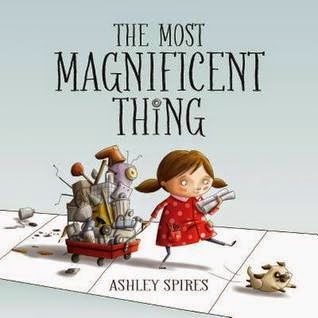
Learning from Picture Books: The Most Magnificent Thing

Since I have two daughters that love to create things, I really loved this story about creativity and persistence. And I especially liked the doggy assistant!


Here's the summary from Amazon.ca:

Award-winning author and illustrator Ashley Spires has created a charming picture book about an unnamed girl and her very best friend, who happens to be a dog. The girl has a wonderful idea. "She is going to make the most MAGNIFICENT thing! She knows just how it will look. She knows just how it will work. All she has to do is make it, and she makes things all the time. Easy-peasy!" But making her magnificent thing is anything but easy, and the girl tries and fails, repeatedly. Eventually, the girl gets really, really mad. She is so mad, in fact, that she quits. But after her dog convinces her to take a walk, she comes back to her project with renewed enthusiasm and manages to get it just right.

For the early grades' exploration of character education, this funny book offers a perfect example of the rewards of perseverance and creativity. The girl's frustration and anger are vividly depicted in the detailed art, and the story offers good options for dealing honestly with these feelings, while at the same time reassuring children that it's okay to make mistakes. The clever use of verbs in groups of threes is both fun and functional, offering opportunities for wonderful vocabulary enrichment. The girl doesn't just "make" her magnificent thing -- she "tinkers and hammers and measures," she "smoothes and wrenches and fiddles," she "twists and tweaks and fastens." These precise action words are likely to fire up the imaginations of youngsters eager to create their own inventions and is a great tie-in to learning about Science, Technology, Engineering and Math.

The Most Magnificent Thing, written and illustrated by Ashley Spires was published by Kids Can Press in 2014.

My thoughts as a writer:

The author really captures the emotional experience of trying, being frustrated, getting angry, and then taking another look and going on (much like the process of writing). I loved the simplicity and power of the text in this story. One of my favourite parts was “She makes things. He unmakes things.” I especially liked the way the author gave the main character space to resolve her angry and upset feelings on her own, instead of having an adult step in with a solution. “Bit by bit, the mad gets pushed out of her head.”

The illustrations in this story go so well with the text. I love the expressions on the girl’s and the dog’s faces as they work on their project. There are lots of details that children can explore when looking at this book on their own.

My thoughts as a teacher:

As a teacher, there are so many ways to use this book! Young children will relate to the emotional side of the story, where the girl gets frustrated because her ideas don’t match up to her vision. I would love to use this to spark some discussion with students about ways to manage angry feelings – and draw their attention to the strategy of just walking away for a little while. 

The illustrations and style of art in this story would also be great for modeling an art style students could try to create their own work, using the technique of adding colour for emphasis or for the important parts of the story (perhaps comparing and contrasting with other books that use a similar style, such as Steve Light’s Have You Seen My Dragon?).

Themes: creativity, persistence, coping with frustration, angry feelings

Ages: 2 - 6

Some possible activities:

- provide recycled materials and encourage students to create their own “magnificent things”
- create a plan for a “magnificent thing” and make a list of materials needed
- have students think about a time when something went wrong, and how they solved their problem
- choose a favourite illustration from the story and discuss why they like it
- talk about the reasons why the illustrator chose her technique and use this style to create their own art 


If you're looking for more great picture books to read to your class or to investigate as a writer, consider checking out the list of Perfect Picture Books, put together by author Susanna Leonard Hill.