Wednesday, October 14, 2026

Three Picture Books About Fall and Friendship

 
Now that we’re a month or so into school, the kids in my class are beginning to make friendships. When I’m planning books to read in October, I try to include books that give my students opportunities to discuss different aspects of friendship wrapped in the warmth of cozy fall settings.


THE SWEATER: A Story of Community, written by Larissa Theule and illustrated by Teagan White, published by Viking Books for Young Readers

This touching story of a community of animals caring for a bird is lovely for helping kids think about kindness and caring for each other. There are also fun opportunities for STEAM activities in making tiny houses or items for each other.


A VERY BIG FALL, written and illustrated by Emmy Kastner, published by Clarion Books.

I love how the three different leaf characters in this book show different reactions to the same situation. This book also includes different types of leaves, which I can connect to leaf-tracing activities for art.


LITTLE GHOST MAKES A FRIEND, written and illustrated by Maggie Edkins Willis, published by Simon & Schuster Books for Young Readers.

Sometimes making friends requires a little bit of bravery before you make a bond where you can be yourself. I love how this book shares some worries related to making a friend. I’m sure this one will inspire lots of storytelling.


I’m excited to see how these choices will encourage my students to open up and discuss their feelings about making friends.

Thursday, August 27, 2026

Three Picture Books I’m Using to Talk About Feelings This September

One of the best things about back to school planning is choosing which books I’m going to read aloud to my class! September is so busy with getting to know each other, learning routines and procedures, adjusting to our schedule, starting curriculum. It’s a lot. I make sure every day has at least one read aloud to spark discussion about feelings and emotional problem solving. 


The Cloud That Stuck, written by Karen Krossing, illustrated by Dorothy Leung, and published by Charlesbridge.

Not all problems are easily solved and feelings don’t always go away quickly. I’m hoping this book will help my students understand that it’s okay to feel their feelings and there are ways to manage them.


Waffles & Julius, written and illustrated by Ed Vere, published by Balzer & Bray.

Books that share important messages in a humorous way are so helpful! I will be sharing lots of different books about the importance of giving others space, including physical space.


I’m Sorry
, written by Michael Ian Black, illustrated by Debbie Ridpath Ohi, published by Simon & Schuster Books for Young Readers.

Kids need to know its okay—and important—to use the word sorry. I love how this book emphasizes talking and sharing feelings. I think this book will spark a lot of discussion.


So excited to share these books with my new class!

Wednesday, September 18, 2024

Learning about seasons with DEAR STREET by Lindsay Zier-Vogel & Caroline Bonne-Muller

Painting of girl looking out window onto street with buildings, people, trees
Why this book?

I found this story when doing some research for my grade 1 class when we were learning about community. My students kept talking about the book, even weeks afterward.

My thoughts as a creator:

This book is a great example of how to incorporate many layers into a picture book. It includes seasonal changes, letter writing, taking different perspectives, noticing things in the environment and taking steps for social change. I would study this one to learn about how to create a fun story while including lots of layers. The illustrations are lots of fun with many shapes and patterns.

My thoughts as an educator:

With all the layers in this book, there is a huge potential for using this as a mentor text in the classroom. I especially liked the way it shows different perspectives on the same place. I thought it would be great for inspiring an inquiry about the school neighbourhood, which could be returned to over the different seasons of the year. It was nice to see thought bubbles and letter writing as examples kids could use for their own writing.

Ages: 5 - 9

Grades: Gr 1 - 4

Connections: community, kindness, taking action, letter writing

Activities:

Art/Social Studies:  Discuss all the patterns in the illustrations. Encourage student to create their own “street scene” using different patterns. Which season would they like to show in their scene? A part II of this activity could be to use a paper doll template to create themselves  and “dress themselves for the weather” so they can put themselves in the scene.

You could also connect this to a neighborhood photo walk using this lesson from the Art Gallery of Nova Scotia  (click HERE)

Or learn about seasonal changes through a resource guide about the art of Maud Lewis from Art Canada Institute (click HERE)

Literacy/Drama: After discussing the different perspective of the girl and the people in the neighborhood, encourage students to share their understanding through a drama activity. In pairs, kids could work together to share their different points of view about different types of weather or seasonal occurrences  (e.g., snow, rain, sunshine, wind, leaves changing colours etc). Volunteers could present their “skit” to the class.

Social Studies Inquiry: Set up a centre where students can note observations about the neighborhood or a street outside your school. Take a walk and make observations. Have students draw and label what they notice. What might they want to learn more about? Make predictions about how the street or neighborhood will change during different weather conditions. What would they see? Why?


Visit the author online (click on the name):

Lindsay Zier-Vogel


Visit the illustrator online:

Caroline Bonne-Muller


Visit the publisher online:

Kids Can Press

*They provide a cute letter writing template for photocopying


Wednesday, August 21, 2024

Learning about the Métis culture - MÉTIS LIKE ME

One of the things I love about reading children’s books is the opportunity to learn new things. I was delighted to find this book. It gave me a chance to learn more about the Métis culture. I discovered this book after seeing it mentioned in the children’s book recommendation feed on Bluesky. (Find me on Bluesky: @andreamack.bsky.social).


Why this book?

Three children lying on the ground with beaded flowers and leaves around them

At first, I was first drawn to the playful illustrations, but I especially loved the way the book shows how different children experience their culture and celebrate their heritage. It's unique in the way it honors different perspectives and experiences. 


My thoughts as a creator:

I haven't seen a picture book told with the perspectives and voices of several different children. I thought this structure was a good way to bring in the idea that individuals experience their culture and heritage in different ways. 


My thoughts as an educator:

This book provides a window into a culture and heritage that I don't know much about myself, so I'm looking forward to sharing it with my grade 1 students. I think they will find many different ways to connect to this story. I also really liked the positive approach to learning more about your own cultural background, even if you don't know much about it. I think this would inspire some young children to ask questions about their own heritage. 

Ages: 4 - 9

Grades: K - 3

Connections: Metis culture, Indigenous learning, individuality,  

Activities:

Social Studies:  Make a list with students: What are some of the elements of Métis culture that you noticed in the story? What are some important aspects of your own culture? Encourage students to draw or write about an aspect of their own culture. Why is it important to you?

STEAM: Explore some Métis dot designs. I found this really interesting explanation and demonstration of Metis dot art with some background information from Lacombe Tourism (click HERE) . I also found a shorter video with a dot art drawing activity from Richmond Art Gallery (click HERE). 


Visit the author online (click on the name):

Tasha Hilderman 🍁

Visit the illustrator:

Risa Hugo 🍁

Visit the publisher:

Tundra Books (Penguin Random House) 🍁


I also found this news interview with the author from CITL CKSA:


Wednesday, August 7, 2024

OLIVETTI by Allie Millington - a typewritten mystery

 A story from the perspective of a typewriter is a first for me! I heard about this one from the #kidlit chat on Bluesky and had to check it out.(Visit the Bluesky Kidlit/YA Book Recommendations Feed to see many more book recommendations).


Why this book?
black typewriter with flowers above it

I remember using a typewriter ages ago. I used one to type out one of the first stories I wrote for a writing contest. It might even have been an Olivetti. I was curious about this story because we hardly ever see typewriters anymore. I also wondered whether the story would interest kids who may have never seen one before. There was a lot to the story!

My thoughts as a creator:

The structure of alternating points of view between the typewriter and human boy was an interesting choice. I enjoyed thinking about how the author used a different voice for each of these characters. There's a lot of humor in the writing, but it evokes a great deal of emotion, too. Plus, how cool is it that a typewriter types messages to communicate?

My thoughts as an educator:

This story doesn't have as much action as some stories, but I still think it would hold the attention of readers. It deals with some challenging topics and issues. There is interesting vocabulary to talk about as well as a mystery that Ernest, the boy, is trying to solve. He is also dealing with anxiety, a familiar issue for many kids. This story also provides an opportunity to learn about the writing technique of "flashbacks."

Ages: 10 - 14

Grades: 5 - 7

Connections: typewriters, mysteries, family, anxiety, memories, grief

Activities:

Literacy: Think about the characters of Olivetti, Ernest and his friend, Quinn. What is the same or different about how they solve problems? Which one is more like you?

Literacy:  Brainstorm some ideas for what an inanimate object might want to say to someone (e.g., perspective of your phone or pencil case). Write a story where the object needs to solve a problem. Try to stay in the object's perspective. 


Visit the author online:


Visit the publisher:

Feiwel & Friends 

Friday, July 26, 2024

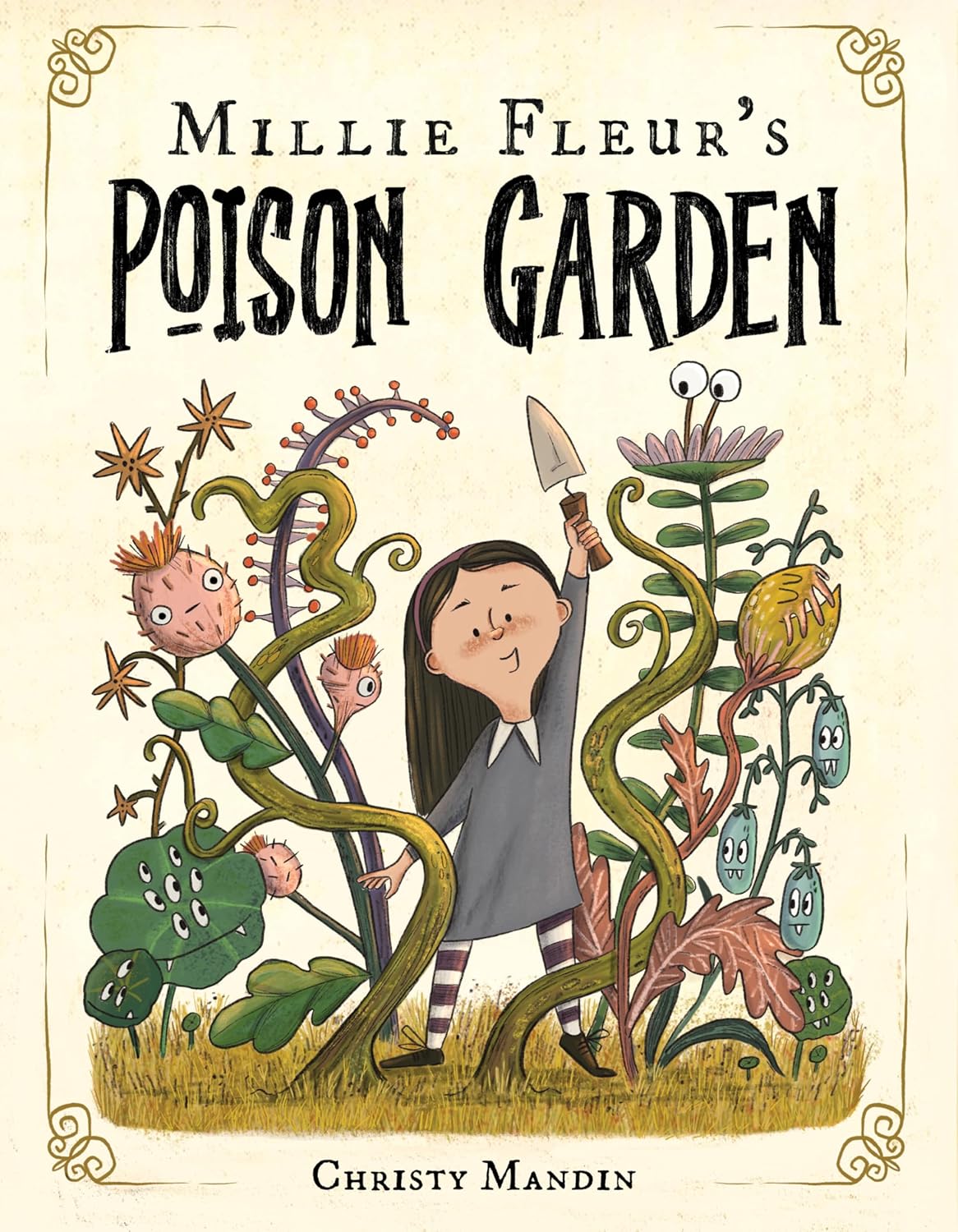
Inspire young gardeners with MILLIE FLEUR'S POISON GARDEN


I'm always on the lookout for charming and unique picture books and I recently discovered this one through a recommendation on Bluesky. I'm looking forward to sharing more of my Bluesky book discoveries along with tips and ideas for using them in the classroom. 

(Find me on Bluesky: @andreamack.bsky.social).


Why this book?

Young girl with trowel in the middle of a garden of plants with eyeballs and tentacles

I love hanging out in my garden, so I couldn’t pass up the chance to check out this delightful picture book by author-illustrator Christy Mandin. This story is such fun for curious young gardeners! It will no doubt inspire some interesting STEAM and writing projects. 


My thoughts as a creator:

I love the unique twist on the theme of gardening with Millie's very unusual plants. The title made me curious! It was a bit of a surprise that the story in this picture book was charming and not at all scary. I can imagine the illustrations were a lot of fun to work on as there are lots of creative garden possibilities like “tentacled tansy.” The color scheme is in natural tones and reminds me of nature.


My thoughts as an educator:

There can never be too many stories with the theme of celebrating being yourself and following your own passion! This picture book would work well as part of a unit about growing plants and also would be a nice book for talking about developing creative writing ideas.  

Ages: 4 - 7

Grades: K - 2

Connections: plants, individuality, being yourself, creativity 

Activities:

Social Emotional Learning:  Millie's passion was her garden, but what are other things people might care strongly about? Encourage students to draw a picture of one of their own unique interests. What makes you special?

STEAM: Design your own unique and weird plant for Millie's garden. Will your plant be creepy or interesting? What unique features might it have and how will they help the plant survive? 

Students can make weird plants in 3D! Provide paper scraps in a range of colours, along with scissors and glue. Demonstrate different ways to tear, bend and fold the paper and encourage students to create different features of the plant.

STEM/Science: Provide "mystery seeds" (e.g., beans, lentils, marigolds, sunflowers) for students along with flower pots and soil. What might grow? Students can make observations and predictions about their growing plants. 

Literacy: Retell the story. Question to discuss: Why did the people in the town get upset about Millie's garden?


Visit the author-illustrator online:

Christy Mandin

Visit the publisher:

Orchard Books/Scholastic


Check out the trailer for Millie Fleur's Poison Garden:


Thursday, November 30, 2023

3 in 3 (and tea) Episode #4

It's time for another episode of 3 in 3 (and tea) with Debbie Ridpath Ohi and me!  We feature 3 children’s books by Canadian authors and/or illustrators and share a few tips and resources for using them in the classroom. 

In Episode 4, we explore a picture book and a middle grade novel about girls taking on new challenges, and a bonus middle grade novel with a touch of bling! (If you want to catch up on other episodes, you can find them on Debbie's 3 in 3 playlist -- or click here: Episode 1, Episode 2, Episode 3). After you watch the video, click on the titles or book covers below to find out more about the books and a few teaching ideas. 


Picture Book:


Girl in hockey gear head on with hockey stick and puck


Summary:
   Lucy learns a new sport and a little about being brave and the importance of practice. With lots of hockey vocabulary, this story will inspire kids to talk about their own adventures with one of Canada's traditional sports. 


Learn about the book creators:

Author: Lisa Bowes 🍁

Illustrator: James Hearne🍁


Visit the publisher:

Orca Books🍁


Activities & resources HERE.


Middle Grade:

Nervous looking red haired girl facing a counter with two cakes and a movie "action' sign bearing the author's namer

Alice Fleck's Recipes for Disaster


 Summary: Alice tries a new experience when she enters a Victorian cooking show with her dad. She soon finds out someone is sabotaging the contest and has a mystery to solve with her new friends. A fun and tasty read with lots of learning about friends and family relationships.


Visit the author online:

Rachelle Delaney 🍁  


Visit the illustrator:

Morgan Goble 🍁


Visit the publisher:

Tundra Books/Puffin Canada 🍁


Activities & resources HERE.


Bonus Middle Grade Novel:


Summary:
 
 Nikki Tesla and her friends have a mystery to solve and it involves a mysterious ring. I love the way this story blends science with action and a cast of characters that all have their own special skills.


Visit the author:

Jess Keating🍁 


Check out the illustrator:

Lissy Marlin


Visit the Publisher:

Scholastic


Activities & resources HERE.


**Want to know more about Canadian author/illustrator Debbie Ohi? Visit her website where you'll find lots of great downloads for teachers!


**We're very grateful to The Faithful Sidekicks for writing and performing our theme song! You can learn more about them at their website.