Showing posts with label picture books with animals. Show all posts

Thursday, March 14, 2019

PENGUINAUT! by Marcie Colleen & Emma Yarlett – A nervous penguin bravely takes on an out-of-this-world adventure


What a fun story about working towards goals and being brave!

Summary from the publisher: 

Orville the penguin lives at the zoo, surrounded by animal pals who go on exciting adventures. A hang gliding rhino! A deep-sea diving giraffe! Orville struggles to keep up, until one day he concocts an adventure all his own: build a spaceship and fly to the moon all by himself. Can one tiny penguin get there alone?

Penguinaut! is perfect for every child who's said, "I can do it myself!" and comes to find that the rewards are much richer when shared with friends. Marcie Colleen's playful text and Emma Yarlett's charming, whimsical illustrations are sure to delight both children and their parents.

Penguinaut! was written by Marcie Colleen and illustrated by Emma Yarlett. It was published  in 2018 by Orchard Press, an imprint of Scholastic.


Opening:    
 
Orville was small.

His friends were big.

And their adventures were bigger.


My Thoughts as a Writer:

This is an engaging story with gentle humor and simple but fun language, such as “perfectly penguin-sized.” The author has managed to bring out several different emotions within the adventure theme, so it’s a great one to study for thinking about adding different layers to a picture book text. I love the illustrations, especially the one where Orville draws the plans for his rocket. All the characters in the story have characteristic expressions and there are so many fun details for kids to notice as they read the pictures.

My Thoughts as an Educator:

This is a versatile book for reading aloud in the classroom! It shows perseverance and independence in Orville’s attempts to build his rocket, creativity and imagination as he builds with different materials, and emotions of anxiety and excitement. It’s lovely the way Orville’s friends engage in a little kindness and write him a note of encouragement.

Ages: 3-7

Grades: K – 2

Themes: adventure, perseverance, creativity

Activities:

Draw: Have you ever had an adventure? What adventure would you like to have? Draw a picture!

STEAM: Build a rocket ship using cardboard boxes and other recyclable materials that can fit more than one person or toy. Where would travel in your rocket?

Share an act of kindness: Write someone you know a kindness message, like Orville’s friends did in the story. Then hide it someplace where they will find it!

Thursday, November 19, 2015

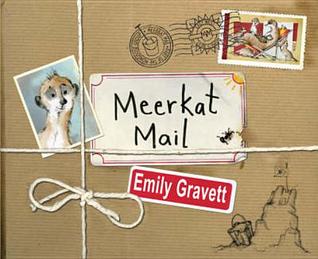
Learning from Picture Books: MEERKAT MAIL


Even though I mostly review recent picture books, when I saw this in the library I had to pick it up, fondly remembering visits to the meerkat exhibit at the zoo.  And then I discovered it contained postcards! A lot of fun.

Summary from Amazon.com
 
Stay safe, stay together!

Sunny the meerkat lives with his enormous family in the Kalahari desert. They are all very close . . . so close, in fact, that one day Sunny decides he's had enough and packs his bags. He's off to visit his mongoose cousins. But from the watery world of the Marsh Mongoose to the nocturnal lifestyle of the Malagasy Mongoose, Sunny just doesn't fit in. And who's that shadowy figure who seems to be following him around?

Meerkat Mail was written and illustrated by Emily Gravett. It was published by Macmillan Children’s Books in 2006.

My Thoughts as a Writer:

The cover is so intriguing, since it looks like a paper-wrapped parcel. The endpages are covered with meerkat family photos and news clippings. And I love the line and gesture in the meerkats.

As for the writing, it’s a fun concept to have Sunny leaving home and sending postcards back from really interesting places. It would’ve been even more fun if there was more information about the different animals he visited to add another element for learning, but I enjoyed reading his messages to his family.  

My Thoughts as a Teacher:

This book is useful for so many things! It’s a good introduction to the idea of postcards and kids will love lifting the flaps. It’s also a great lead in to discussion about different kinds of families and homes and their differences (and maybe similarities). This would also be nice to pair with some non-fiction texts about meerkats and to talk about habitats.  

Themes: nature, family, mail,
Ages: 4 – 8
Grades: preschool – grade 3
Follow-Up Activities:
  • Research a place you’d like to visit and write a postcard!
  • Find out more about meerkats and their habitats. Where do they live? What do they eat?
  • Discuss: Would you ever want to leave home? Why or why not?
  • Write a story or draw a picture about setting off on an adventure. What would you bring?


To find more great picture books to read or to use in your classroom, visit author Susanna Leonard Hill's website for her theme-based summary of Perfect Picture Books posted by book-loving bloggers on Perfect Picture Book Friday.


Thursday, August 6, 2015

Learning from Picture Books: Hermelin the Detective Mouse

Here’s a true confession about me: When I was around 10, I used to make little mice out of pipe cleaners and felt, and created entire families and little houses, complete with their family trees.  So it’s not surprising that I went to find this book right away when it became available at my library.

Mini GreyHere’s the summary from Amazon:

Hermelin is a special little mouse. He was born in a box of cheese and lives in an attic at 33 Offley Street. He can read books and type notes on his typewriter. Most importantly, Hermelin can solve mysteries. And the people of Offley Street are in need of a detective!

Again and again, Hermelin is on the case—the anonymous hero. But when his neighbors invite him to a thank-you party in his honor and find out who Hermelin really is—a MOUSE!—will he still be welcome on Offley Street?

Hermelin, the Detective Mouse was written and illustrated by Mini Grey, and first published by Alfred. A. Knopf in 2013.

My thoughts as a writer:

The delightful illustrations of what was happening in the town, with small speech bubbles and “notices” captured my attention. But I also loved the charming voice of Hermelin, right from the opening line: “Well, I was trying out the new binoculars that I’d found in my breakfast cereal this morning.”

This will be an interesting book for both writers and illustrators to study. For writers, it’s an interesting example of a story told in first person, which is not that common in picture books. It’s also a mystery! Although I’m not an illustrator, I noticed lots of creative design elements in this book, such as notes typed on a typewriter, speech bubbles, labels on packaging, newspaper clippings, invitations, a dictionary and banners, as well as visuals that show a mouse’s perspective.

My thoughts as a teacher:

This would be a fun story to encourage students to pay attention to the world around them. It would be useful in teaching perspective-taking, and could be compared to the movie Ratatouille. Because of all the small signs and details, I think slightly older elementary students would enjoy it too.

Themes: detectives, being observant, city life, making friends

Ages: 4 – 8

Grades: K – grade 3

Follow-Up Activities:

Create your own detective character, and think of a mystery for them to solve. Create clues! Or, write about what mini-mystery Hermelin and Emily might solve next!

Study some different labels and see what words you can find!

Create a piece of art using labels, pieces of newspaper, lists and wrappers.

Draw a picture or write a story that describes how the world looks to a creature that is very different from yourself.


Thursday, December 11, 2014

Learning from Picture Books: This is a Moose

This book is so much fun! The publisher’s description calls it hilarious and I definitely agree. 


Here's the summary from Amazon:

Lights! Camera! Moose!

MOOSE? Yes, Moose! When a movie director tries to capture the life of a moose on film, he's in for a big surprise. It turns out the moose has a dream bigger then just being a moose--he wants to be an astronaut and go to the moon.

His forest friends step in to help him, and action ensues. Lots of action. Like a lacrosse-playing grandma, a gigantic slingshot into space, and a flying, superhero chipmunk.

In this hilarious romp, Richard T. Morris and bestselling illustrator Tom Lichtenheld remind us to dream big and, when we do, to aim for the moon.

This is a Moose, written by Richard T. Morris and illustrated by Tom Lichtenheld, was first published in 2014 by Little, Brown and Company.,

My thoughts as a writer:

This book is a conversation between a director (unseen for most of the story) and the narrator as well as the Moose and a couple of other animal characters. It’s a great concept that is executed with lots of humor and surprises. There were a lot of interesting characters, especially Grandma Moose. 

This book shows a real partnership between the work of the author, the illustrator and the book designer. The text that is told through speech bubbles changes color, size and font to reflect the emotions of the unseen director.

My thoughts as a teacher:

Children will love the humor in this book! There is a wonderful message about being persistent and following your own dreams, though the message is subtle and secondary to the fun. It also would provide an opportunity to talk about animals and how they are adapted for their own habitats.

A fun activity related to this book might be to have students create their own short story about an animal of their choice that doesn’t act as expected in their own movie (involving research about their animal to find out what it’s normal behaviour would be). Another idea might be to take one of the characters in the story and think about what its secret dream might be and write or draw a picture about it.

If you're looking for more great picture books to read to your class or to investigate as a writer, author Susanna Leonard Hill has a wonderful list of Perfect Picture Books.

Thursday, November 13, 2014

Learning from Picture Books: One Cool Friend


This book has so many layers! It's fun to think about as a writer, from the perspective of character and plot, but it's also a good one to engage students and provoke discussion.

Here's the summary from Amazon.com in case you haven't read it yet: 

On a spontaneous visit to the aquarium, straight-laced and proper Elliot discovers his dream pet: a penguin. When he asks his father if he may have one (please and thank you), his father says yes. Elliot should have realized that Dad was probably thinking of a toy penguin, not a real one… Clever illustrations and a wild surprise ending make this sly, silly tale a kid-pleaser from start to finish.

One Cool Friend, written by Tony Buzzeo, illustrated by David Small, published by Dial Books for Young Readers, 2012


My Thoughts as a Writer:

Elliot’s quirky personality is clear right from the first page of this book. I love the line where he finds the penguins: “In their black feather tuxedos with their proper posture, they reminded Elliot of himself.”  The plot had surprising twists that kept me reading to find out what would happen next. And I thought Elliot’s relationship with his father was realistic and really helped create another interesting layer for the story. 

This is a good book to study to learn about story layers and plot twists. It’s fun to go back through the story and look at the clues in the illustrations that point towards the ending.

My Thoughts as a Teacher:

My students would enjoy the humor in this story and the idea of ‘fooling Dad’, which of course is proven out differently in the end. This book would be a fun one to read when talking about penguins, aquarium visits or habitats and how to care for a living creature. And it’s a great story to show how the writer and illustrator used their imaginations. 


A good activity for this book would be for students to think of an animal they’d like to take home from the zoo or aquarium and think about how their own environment would have to change to support the animal. Students could also investigate the explorers Magellan and Captain Cook, and look for places mentioned in the story on a map, e.g. Great Barrier Reef, the Galapagos Islands.


If you're looking for more great picture books to read to your class or to investigate as a writer, author Susanna Leonard Hill has a wonderful list of Perfect Picture Books.

Thursday, August 22, 2013

Learning from Picture Books: Too Tall Houses


Since I’m inescapably drawn to writing picture books as well as middle grade novels, I decided I’d better start reading more of them and figuring out what makes them work.
Too Tall Houses

written and illustrated by Gianna Marino

published by Viking, 2012


From Amazon:

Good friends learn a small but important lesson.

Owl and Rabbit are good friends and live in two small houses next to each other. They are perfectly happy . . . until Rabbit's garden gets in the way of Owl's view. So Owl builds his house a little taller. Only that blocks the sun from Rabbit's vegetables. So Rabbit builds his house taller. And soon it's a house-building frenzy and the two now not-so-good friends have the two tallest houses in the world!

All it takes is a gust of wind to remind them that maybe living smaller and together is a much better way to remain friends.
 

My Thoughts as a Writer:

This book has a simple and easy to relate to concept that is so well-suited for 3- to 7-year-olds. It’s one of those ideas that makes you think “I wish I’d thought of that”, and it’s cleverly executed. Sound words like “plunk” and “creak” are used sparingly in an effective way.

The page breaks help to build the tension and suspense, allowing places where the reader can predict what might happen. I love the way the illustration layout shows the friendship between Rabbit and Owl using double page spreads at first and then single pages as they become competitive and angry at each other.
This is a great book as a model for a problem/solution type of structure and I’d love to have it on my bookshelf to study further.
 
My Thoughts as a Teacher:

I’d love to read this book to my kindergarten students and buy a copy for my classroom! It would be so easy for my students to relate to the competitiveness of Owl and Rabbit, and their the angry feelings and tantrums.
This would make a great read aloud to lead into discussions of cooperation, tolerance in friendship, and social problem-solving. It’s would also be useful for talking about story structure, since it has a well-defined problem and a solution at the end. Some questions might come up about why the Rabbit lives in house and not underground, and could lead to research about these animals.


Saturday, May 18, 2013

Learning from Picture Books: Rocket Writes a Story

Since I’m inescapably drawn to writing picture books when I'm not working on my middle grade novels, I decided I’d better start reading more of them and figuring out what makes them work. So every other Friday, I'll post "Learning from Picture Books" to share what I'm learning.


Rocket Writes a Story
written and illustrated by Tad Hills
published by Schwartz & Wade, 2012

 
From Amazon:
Rocket loves books and he wants to make his own, but he can't think of a story. Encouraged by the little yellow bird to look closely at the world around him for inspiration, Rocket sets out on a journey. Along the way he discovers small details that he has never noticed before, a timid baby owl who becomes his friend, and an idea for a story.
 
My thoughts as a writer:
I liked the way the story brought out some of the realities of the writing process, but I found the story itself a little slow paced and wondered whether it would hold a child’s interest. A little bit of mystery about a nest in a tree helped to carry the story forward and I could study how the illustrations and words worked together to make this effective. Overall, this book seemed best suited for educational purposes, rather than for entertainment.
 
My thoughts as a teacher:
This would be a good book to support a discussion of the process of writing. I appreciated the way the story showed how much hard work goes into writing and how a story can continue to change as the writer thinks of new ideas or re-reads what is written.
This story also showed how we can be inspired by nature, which fits with the Reggio Emilia philosophy of teaching. However, the story itself was a little quiet for me and could have benefited from a bit more action or conflict. This book would be suitable for grades K-2, but in a kindergarten class, I might break up the reading into a couple of sessions, since it’s long for a picture book.