Showing posts with label contemporary picture books. Show all posts

Wednesday, September 18, 2024

Learning about seasons with DEAR STREET by Lindsay Zier-Vogel & Caroline Bonne-Muller

Painting of girl looking out window onto street with buildings, people, trees
Why this book?

I found this story when doing some research for my grade 1 class when we were learning about community. My students kept talking about the book, even weeks afterward.

My thoughts as a creator:

This book is a great example of how to incorporate many layers into a picture book. It includes seasonal changes, letter writing, taking different perspectives, noticing things in the environment and taking steps for social change. I would study this one to learn about how to create a fun story while including lots of layers. The illustrations are lots of fun with many shapes and patterns.

My thoughts as an educator:

With all the layers in this book, there is a huge potential for using this as a mentor text in the classroom. I especially liked the way it shows different perspectives on the same place. I thought it would be great for inspiring an inquiry about the school neighbourhood, which could be returned to over the different seasons of the year. It was nice to see thought bubbles and letter writing as examples kids could use for their own writing.

Ages: 5 - 9

Grades: Gr 1 - 4

Connections: community, kindness, taking action, letter writing

Activities:

Art/Social Studies:  Discuss all the patterns in the illustrations. Encourage student to create their own “street scene” using different patterns. Which season would they like to show in their scene? A part II of this activity could be to use a paper doll template to create themselves  and “dress themselves for the weather” so they can put themselves in the scene.

You could also connect this to a neighborhood photo walk using this lesson from the Art Gallery of Nova Scotia  (click HERE)

Or learn about seasonal changes through a resource guide about the art of Maud Lewis from Art Canada Institute (click HERE)

Literacy/Drama: After discussing the different perspective of the girl and the people in the neighborhood, encourage students to share their understanding through a drama activity. In pairs, kids could work together to share their different points of view about different types of weather or seasonal occurrences  (e.g., snow, rain, sunshine, wind, leaves changing colours etc). Volunteers could present their “skit” to the class.

Social Studies Inquiry: Set up a centre where students can note observations about the neighborhood or a street outside your school. Take a walk and make observations. Have students draw and label what they notice. What might they want to learn more about? Make predictions about how the street or neighborhood will change during different weather conditions. What would they see? Why?


Visit the author online (click on the name):

Lindsay Zier-Vogel


Visit the illustrator online:

Caroline Bonne-Muller


Visit the publisher online:

Kids Can Press

*They provide a cute letter writing template for photocopying


Thursday, July 13, 2017

Learning from Picture Books – JABARI JUMPS by Gaia Cornwall

I loved this story! It’s a perfect summer read, since so many kids are facing their own swimming pool challenges at this time of year. When I read this book to my kindergarten students in June, they really enjoyed it!

Summary from the publisher:

Jabari is definitely ready to jump off the diving board. He’s finished his swimming lessons and passed his swim test, and he’s a great jumper, so he’s not scared at all. “Looks easy,” says Jabari, watching the other kids take their turns. But when his dad squeezes his hand, Jabari squeezes back. He needs to figure out what kind of special jump to do anyway, and he should probably do some stretches before climbing up onto the diving board. In a sweetly appealing tale of overcoming your fears, newcomer Gaia Cornwall captures a moment between a patient and encouraging father and a determined little boy you can’t help but root for.

Working up the courage to take a big, important leap is hard, but Jabari is almost absolutely ready to make a giant splash.

Jabari Jumps was written and illustrated by Gaia Cornwall. It was published in 2017 by Candlewick Press.

Opening:

“I’m jumping off the diving board today,” Jabari told his dad.

My Thoughts as a Writer:

This story has the kind of simple but perfect concept that many picture book writers are looking for. Most kids can relate to some kind of swimming challenge, whether putting their head under or jumping in, or, like Jabari, trying the diving board. I really loved how the author portrayed the relationship between Jabari and his dad. The support of Jabari’s family is with him, even when he’s making his own decisions.

I also loved the size of this book, the diversity of the characters and the subtle but playful use of different textures in the illustrations.

My Thoughts as a Teacher:

There's a lot of scope for lessons related to this book! I might have students make predictions about what will happen in the story, and talk about emotions and feelings based on Jabari’s actions and expressions. It would also be a great way to start a discussion about discussions about fears and strategies for coping with them, beginning with Jabari’s strategies of taking a deep breath or taking his time to think and be ready. 

Although this is probably not the intent, adults can learn a lot from this book too, in the way that Jabari’s dad calmly lets Jabari make his own decision about whether to jump or not.

Ages: 4 - 8

Grades: K - 3

Themes:  swimming, facing fears, bravery, family

Activities:

What challenges have you faced when learning something new? What did you do when you felt scared?

Think about something you are scared to try. Draw a picture to show how you might do it or write a list of steps to get past your fears.

Check out this interview with Gaia Cornwall about the book:


Thursday, April 6, 2017

Learning from Picture Books – ARE WE THERE YET? by Dan Santat

A great choice if you're interested in interactive picture books. Or wanting something to read on a long car trip!

Summary from the publisher:


"Are we there yet?" Every parent has heard this classic kid question on a long car ride--and after reading this astonishingly inventive new book (that even turns upside down for several pages!), you'll never look at being bored the same way again.

Let's face it: everyone knows that car rides can be boring. And when things get boring, time slows down. In this book, a boy feels time slowing down so much that it starts going backward--into the time of pirates! Of princesses! Of dinosaurs! The boy was just trying to get to his grandmother's birthday party, but instead he's traveling through Ancient Egypt and rubbing shoulders with Ben Franklin. When time flies, who knows where--or when--he'll end up.

Are We There Yet? was written by and illustrated by Dan Santat. It was published in 2016 by Little, Brown and Company.

Opening:

“The car trip to visit Grandma is always exciting! But after the first hour, it can feel like an eternity.”

My Thoughts as a Writer:

Dan Santat has taken the classic “joke” of a long car trip and turned it into an entertaining story. I loved the expressions on the character’s faces and the interactive element of turning the book to “go back in time” is so clever! The detailed illustrations invite the reader to take their time and the comic book style frames with speech bubbles were so cool! I also really liked the deeper layer of meaning that is hinted at: “And you never know where life may take you…”

My Thoughts as a Teacher:

It would be fun to talk about the different time periods shown in this story. This book could also be used as a starting point for discussing different modes of transportation. An interesting project might be to look at a few of the different books Dan Santat has illustrated to study his illustration style.

Ages: 4 - 8

Grades: K - 3

Themes: family, imagination, car trips,

Activities:

If you were in the car on the way to Grandma’s house, what “side trip” would your imagination take you on. Draw a picture to show where you’d travel.

Create a paper book with a few pages and try to recreate the cool reversal that happens in this story to see how it works. Use arrows to show where the story goes.

What is your favorite scene from the story? Explain why.

Check out this fun book trailer:


Thursday, January 5, 2017

Learning from Picture Books – BEAUTIFUL

I'm excited to start off 2017 with this wonderful picture book that promotes diversity and positive self-image. As a teacher and as a mother, I'm always looking for books that show children, and especially girls, of different shapes, sizes and abilities, as confident and multi-talented. I recommended this book to my local library to purchase for their collection.
Summary from the Publisher:

Every girl is unique, talented, and lovable. . . .Every girl is BEAUTIFUL.
Much more than how one looks on the outside, true beauty is found in conquering challenges, showing kindness, and spreading contagious laughter. Beautiful girls are empowered and smart and strong!

BEAUTIFUL breaks barriers by showing girls free to be themselves: splashing in mud, conducting science experiments, and reading books under a flashlight with friends. This book will encourage all girls to embrace who they are and realize their endless potential.

Beautiful was written by Stacy McAnulty and illustrated by Joanne Lew-Vriethoff. It was published in 2016 by Running Press Kids.

Opening:

“Beautiful girls…have the perfect look.”

My Thoughts as a Writer:

The text is simple, celebrating different aspects of beauty for girls. The illustrations are the key to developing the underlying message that beauty is found in many different ways – showing girls as adventurers, scientists, and creators. This is a good text for studying how the text and illustrations work together.

My Thoughts as a Teacher:

I love the message that all girls are beautiful no matter how they dress or act, and that girls can do anything. I’d love to read this to my class to see how they react to it. The illustrations include confident girls with different skin colors and body types. It’s a good book for promoting self-acceptance. Every child’s library should include this book.

Ages: 3 - 7

Grades: PreK - 2

Themes: self-acceptance, diversity, beauty, empowerment

Activities:

What does beautiful mean? Make a list of all the different ways of showing beauty.

Make a “beautiful” class book by having each student draw a picture of a friend (male or female) and write about what makes them beautiful.


Create a mirror template. Have each child draw a self-portrait inside the mirror that shows something awesome about themselves. Write an explanation or sentence about what makes them beautiful.

Thursday, March 17, 2016

Learning from Picture Books: HENRY HOLTON TAKES THE ICE

The illustrations in this book show lots of details about hockey and ice skating. This is another one of the picture books nominated for the Ontario Library Association's Blue Spruce Award. 


Henry Holton’s whole family is hockey mad.  Everyone, that is, except Henry.  When he holds a
hockey stick, Henry becomes a menace to the game—and an embarrassment to his sports-minded family.  It’s not until he sees his first ice dancing performance that Henry realizes there’s something he can do on the ice that doesn’t involve boarding and body checking.  Henry is ready to hang up his gear and try on some figure skates, but first he has to convince his hockey-obsessed family to let him follow his own path.

Henry Holton Takes the Ice, written by Sandra Bradley, illustrated by Sara Palacios and published by Dial Books for Young Readers in 2014.

First line: “Henry Holton’s dad played hockey. So did his mom, his grandfather, his uncle, all twenty-three of his cousins and his big sister, Sally.”

My thoughts as a writer:

The story follows a traditional plot where the main character is different than the other people close to him, and, after trying things their way, is eventually recognized for his own unique talents. I haven’t come across many other books about boys and figure-skating, so I think that’s a real hook to pull me into this story.

The illustrations are fun and contain interesting details, suggesting the illustrator spent a lot of time making observations at skating arenas! I wish there was more ethnic diversity in the scenes with groups of children on ice.

My thoughts as a teacher:

I really liked the message behind the story, since it opens the door to good discussion about “boy activities” vs. “girl activities” and not being limited by gender.  It was nice that Henry’s grandmother had an important role in the story.

Ages: 4 – 8

Grades: K - 3

Themes: individuality, ice skating, hockey, grandparents

Activities:

Henry’s grandmother surprised him when he found out about her past. Interview one of your older relatives to find out what sports or activities they liked to do when they were younger.

What are some other activities that people think are usually mostly done by girls? Boys? Draw a picture or write a story to showing a boy or girl doing an activity that might be surprising to some people.


For more great picture books, visit author Susanna Leonard Hill's original theme list of Perfect Picture Books on her blog or this theme list with links to Pinterest collections on each theme - a very helpful resource!

Thursday, February 4, 2016

Learning from Picture Books - HOPE SPRINGS


I didn’t know what to expect from the title of this book, but was immediately drawn in by the story.  This is a wonderful story of kindness and community – a great classroom read for all elementary grades.

Summary from Amazon.ca:


A drought has settled in the area around the orphanage where Boniface lives. There are long line-ups at the tiny spring where all the local people get their water, and suddenly the orphans are pushed to the back of the line, unwelcome. Boniface's houseparent, Henry, tells him that the people were mean out of fear--they feared there would not be enough water for their families. When the building of the orphanage's well is completed, Boniface has an idea to help the villagers.

A lovely story of kindness and heart, this story shows that, through compassion and understanding, true generosity can spring from unexpected places.

Hope Springs was written by Eric Walters and illustrated by Eugenie Fernandes. It was published by Tundra Books in 2014.

My Thoughts as a Writer:


This longer picture book opens with a playful introduction to the children at the orphanage to hook the reader in and introduce the characters, even though the problem of not enough water is a serious one. This really began to create a lot of emotion and feelings for the characters, because of the weighty problems and realities of life they need to face.

The illustrator uses realistic, earthy tones that clear showing the details of the story and add to the emotional impact through the character’s gestures and expressions.  

My Thoughts as a Teacher:

This is an important book to read to elementary students. Along with showing the realities of life in Kenya, the scarcity of water and how kids can help, it also shows how kids can take action to be kind and change their situation. 

I enjoyed reading the facts about the water and Eric Walter’s role in helping to bring water to the orphanage and village. This book could provoke a lot of discussion and would be great to pair with other books that show more about the water cycle, e.g., Water Is Water by Miranda Paul or about life in other places.

Themes: community, kindness, drought, life in Africa, water shortages

Ages: 6 – 10

Grades: Grades 1 to 5

Follow-Up Activities:
  • Talk about what your life would be like if there was a water shortage…would North American life be different? What would change?
  • Create a 3-D model to show one of the scenes in the story
  • Research your own “kindness” project and make a list of things you could do to raise money to help
  • Research the author and find out more about his organization The Creation of Hope

Thursday, July 16, 2015

Learning from Picture Books - Kenta and the Big Wave

This book was on the list of nominees for the Blue Spruce Award from the Ontario Library Association this year, but I was absent the day the librarian read it with my class. I'm sorry I missed all the interesting discussion that undoubtedly took place! I'm so glad I can share it here, because it would be a wonderful addition to any classroom or school library. 

Here’s the summary from Amazon:
Ruth Ohi


When tragedy strikes Kenta's small village in Japan, he does all he can to hang on to the things that matter to him most. But amidst the chaos of an emergency evacuation brought on by the tsunami, Kenta and his family must quickly leave their home. Climbing to safer ground, Kenta watches helplessly as his prized soccer ball goes bouncing down a hill and gets swept away by the waves, never to be seen again... that is until it washes up on a beach on the other side of the world, into the hands of a child who takes it upon himself to return the ball to its rightful owner.

In this evocative picture book, Ruth Ohi's glowing art transports the reader to Japan with gentle images that offer reassurance amidst the background of an environmental catastrophe. Inspired by true stories of personal items being washed ashore thousands of miles away after the tsunami of 2011, Kenta and The Big Wave is about the strength of the human spirit and the power of Mother Nature. An afterword explains tsunamis to young readers.

Kenta and the Big Wave was written and illustrated by Ruth Ohi, published by Annick Press, 2015.

My thoughts as a writer:

The opening line drew me in: “When Kenta heard the warning siren, he ran to school.” The text has a lovely, poetic rhythm that fits with the serious mood of the story. I really liked the subtle way this story showed how people triumph by making do as best they can. It shows children that even though the world is much bigger than they can imagine, they can make a difference to another person.

My thoughts as a teacher:

This would be a thought-provoking story to read and discuss with students or your child. It could be used to start a discussion on many different topics:
-  tsunamis and geological-related events
-  what life is like in Japan or other cultures
- what other things might be floating in the ocean (and the environment).
-  ways to be kind

Themes: tsunamis, kindness, global awareness

Ages: 4 – 7

Grades: preschool - 2

Follow-Up Activities:

Visit Ruth Ohi's website to try a message writing activity. 

Make a list of other things that might be washed away during a tsunami. Think about what you might be able to do to help.

Draw or write about something important to you that you would miss if you lost it.

Thursday, May 28, 2015

Learning from Picture Books - The Man With the Violin

I really admired the unique way the illustrator told the story along with the author in this picture book. I’m so glad I was introduced to this story through the nominations for the Blue Spruce Award and my school librarian. It’s really a picture book for all ages, not just children.

Here's the summary from Amazon:

Kathy Stinson & Dusan Petricic


This gorgeous picture book is based on the true story of Joshua Bell, the renowned American violinist who famously took his instrument down into the Washington D.C. subway for a free concert. More than a thousand commuters rushed by him, but only seven stopped to listen for more than a minute. 
In The Man With the Violin, bestselling author Kathy Stinson has woven a heart-warming story that reminds us all to stop and appreciate the beauty that surrounds us.

Dylan is someone who notices things. His mom is someone who doesn't. So try as he might, Dylan can't get his mom to listen to the man playing the violin in the subway station. But Dylan is swept away by the soaring and swooping notes that fill the air as crowds of oblivious people rush by. With the beautiful music in his head all day long, Dylan can't forget the violinist, and finally succeeds in making his mother stop and listen, too.

Vividly imagined text combined with illustrations that pulse with energy and movement expertly demonstrate the transformative power of music. With an afterword explaining Joshua Bell's story, and a postscript by Joshua Bell himself.

The Man With the Violin, written by Kathy Stinson and illustrated by Dusan Petricic, was first published by Annick Press, Toronto in 2013.

My thoughts as a writer:

The opening line drew me right in. I could tell this was going to be a meaningful story. One of the lovely aspects of this story is that although there’s an underlying message about “paying attention” and it lingers with you after reading, it is never once mentioned in the text.

The language of the story really captures the contrast of the noisy subway and the lyrical music, but it’s really the partnership of the text and illustrations that make this book so successful. Through the creative use of colour and line, the illustrator brings out the contrast between the bustle of the subway and the peaceful moments in the music.

My thoughts as a teacher:

This is a story that may need some discussion during or after reading. I really liked the notes about Joshua Bell and the Postscript written by Joshua Bell. It’s wonderful to have the itunes link included to be able to actually play the music from the story. There is a lot to talk about in the illustrations, and especially about how the illustrator uses line and colour.

Although the age-range for this book is listed as 5-8, older students might also appreciate the meaning behind this book. They might also think about the different ways the author used words to convey different feelings and sounds.

Themes: creativity, culture, appreciating the world around you
Ages: 5 – 8
Grades: K - 3

Possible activities for students:

- create art using line and colour while listening to different types of music
- talk or write about a time that they noticed something interesting that others overlooked
- watch this video about the story behind the book with the author and the illustrator 
- discuss this quote from author Kathy Stinson: “The world’s not a bad place if we pay attention a little bit more.”


If you're looking for more great picture books to read to your class or to investigate as a writer, consider checking out the list of Perfect Picture Books, put together by author Susanna Leonard Hill.

Thursday, May 21, 2015

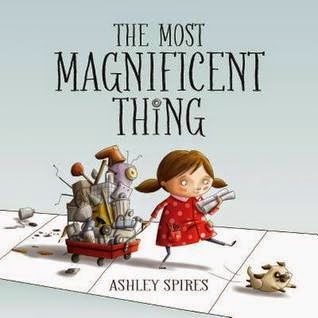
Learning from Picture Books: The Most Magnificent Thing

Since I have two daughters that love to create things, I really loved this story about creativity and persistence. And I especially liked the doggy assistant!


Here's the summary from Amazon.ca:

Award-winning author and illustrator Ashley Spires has created a charming picture book about an unnamed girl and her very best friend, who happens to be a dog. The girl has a wonderful idea. "She is going to make the most MAGNIFICENT thing! She knows just how it will look. She knows just how it will work. All she has to do is make it, and she makes things all the time. Easy-peasy!" But making her magnificent thing is anything but easy, and the girl tries and fails, repeatedly. Eventually, the girl gets really, really mad. She is so mad, in fact, that she quits. But after her dog convinces her to take a walk, she comes back to her project with renewed enthusiasm and manages to get it just right.

For the early grades' exploration of character education, this funny book offers a perfect example of the rewards of perseverance and creativity. The girl's frustration and anger are vividly depicted in the detailed art, and the story offers good options for dealing honestly with these feelings, while at the same time reassuring children that it's okay to make mistakes. The clever use of verbs in groups of threes is both fun and functional, offering opportunities for wonderful vocabulary enrichment. The girl doesn't just "make" her magnificent thing -- she "tinkers and hammers and measures," she "smoothes and wrenches and fiddles," she "twists and tweaks and fastens." These precise action words are likely to fire up the imaginations of youngsters eager to create their own inventions and is a great tie-in to learning about Science, Technology, Engineering and Math.

The Most Magnificent Thing, written and illustrated by Ashley Spires was published by Kids Can Press in 2014.

My thoughts as a writer:

The author really captures the emotional experience of trying, being frustrated, getting angry, and then taking another look and going on (much like the process of writing). I loved the simplicity and power of the text in this story. One of my favourite parts was “She makes things. He unmakes things.” I especially liked the way the author gave the main character space to resolve her angry and upset feelings on her own, instead of having an adult step in with a solution. “Bit by bit, the mad gets pushed out of her head.”

The illustrations in this story go so well with the text. I love the expressions on the girl’s and the dog’s faces as they work on their project. There are lots of details that children can explore when looking at this book on their own.

My thoughts as a teacher:

As a teacher, there are so many ways to use this book! Young children will relate to the emotional side of the story, where the girl gets frustrated because her ideas don’t match up to her vision. I would love to use this to spark some discussion with students about ways to manage angry feelings – and draw their attention to the strategy of just walking away for a little while. 

The illustrations and style of art in this story would also be great for modeling an art style students could try to create their own work, using the technique of adding colour for emphasis or for the important parts of the story (perhaps comparing and contrasting with other books that use a similar style, such as Steve Light’s Have You Seen My Dragon?).

Themes: creativity, persistence, coping with frustration, angry feelings

Ages: 2 - 6

Some possible activities:

- provide recycled materials and encourage students to create their own “magnificent things”
- create a plan for a “magnificent thing” and make a list of materials needed
- have students think about a time when something went wrong, and how they solved their problem
- choose a favourite illustration from the story and discuss why they like it
- talk about the reasons why the illustrator chose her technique and use this style to create their own art 


If you're looking for more great picture books to read to your class or to investigate as a writer, consider checking out the list of Perfect Picture Books, put together by author Susanna Leonard Hill.

Thursday, April 23, 2015

Learning from Picture Books: Blackout!

The book I'm featuring today seems appropriate, after thinking about Earth Day and how to reduce, reuse and recycle. What would you do if there was no electricity? This book might give you some ideas, or at least spark a conversation. It has also been named a Caldecott Honor Book.

Here's the summary from Amazon:


One hot summer night in the city, all the power goes out. The TV shuts off and a boy wails, "Mommm!" His sister can no longer use the phone, Mom can't work on her computer, and Dad can't finish cooking dinner. What's a family to do? When they go up to the roof to escape the heat, they find the lights--in stars that can be seen for a change--and so many neighbors it's like a block party in the sky! On the street below, people are having just as much fun--talking, rollerblading, and eating ice cream before it melts. The boy and his family enjoy being not so busy for once. They even have time to play a board game together. When the electricity is restored, everything can go back to normal . . . but not everyone likes normal. The boy switches off the lights, and out comes the board game again.

Blackout! written and illustrated by John Rocco, published by Disney Hyperion Books, 2011.

My thoughts as a writer:

This book provides a wonderful example of how minimal text works together with illustrations to create a complete reading experience. It’s definitely a book where every word counts. 

The beauty of this book is that it connects to a real experience a family might have had together. It’s a book that can spark conversation, without being preachy. I really admired the pacing.

My thoughts as a teacher:

As a teacher, I might use this book to inspire children to think about their own experiences and memories as ideas for writing. This would be a nice book to read around the time of Earth Day, Earth Hour or Screen Free week (May 4 – 10), because it’s a great lead in to talk about alternatives ways to spend time without using much energy (e.g., board games vs. electronic games) and to get children thinking about what life might be like without electricity.

Themes: family relationships, unplugging from technology,

Ages: 2 - 6

Some possible activities:

- discuss differences in how a blackout might affect people who live in a city vs. people who live in the country or in another place

- make a poster for different activities to do without electricity

- have students think about a time they spent with their family, list details, and draw or write a story

- create their own board game 

For another review of this book, visit Patricia Hilton of Children’s Books Heal. There's also a video interview with John Rocco as a featured author/illustrator for the 12 x 12 picture book challenge.


If you're looking for more great picture books to read to your class or to investigate as a writer, consider checking out the list of Perfect Picture Books, put together by author Susanna Leonard Hill.