Showing posts with label small joys of life. Show all posts

Friday, September 9, 2022

MAGGIE’S TREASURE by Jon-Erik Lappano & Kellen Hatanaka - a book about treasure collecting and community

Girl pulling a wagon loaded with small treasures

Why this book?

My students are always finding all kinds of treasures, so I know they will love this book! I especially connected with the idea of noticing the small or unused things in the world and thinking about how they could be used or re-used. The illustrations are bold and colourful with a fun, distinctive style. 

My thoughts as a creator:

There are some lovely phrases in this story. One of my favourites is, “Maggie saw the sparkle in everything.” A nice book to study when thinking about using your observations of the world to add details to a story.

My thoughts as an educator:

The theme of helping the community is always great to promote activism and encourage students to create their own projects!  It would be interesting to discuss the main ideas in this story in comparison with the picture book Maybe Something Beautiful by F. Isabel Campoy and Theresa Howell with illustrations by Rafael Lopez.

Ages: 4 - 7

Grades: K - 3

Connections: re-using materials, collections, helping the community

Activities:

Active Play & Math – Go on a hunt outside (or inside) to find treasures. Encourage children to sort their “treasures” in different ways. Listen as they explain their reasoning for how they sorted them.

Building Community: What might happen if everyone in the class brought one toy or book they didn’t want any more? Could they be given to others or exchanged with each other?

Community Art Project: Encourage everyone in the class to bring in one “treasure” to glue onto a large board or canvas to create a class art project to display in the classroom.

Create – Give children a small collection of “treasures” such as paper scraps, wood scraps, buttons, pieces of cloth, and string or yarn and some glue and drawing materials. What can they make? A prompt question might be: Can you make something useful? Another creative project might be for everyone in the class to bring in one “treasure” to glue together into

Social-Emotional Learning – Brainstorm with children and help them make a list of things they can do to help someone else. Choose one project to work on together.

Classroom Tip: Keep a “scrap bin” of interesting paper bits that children can use for creating at a Maker’s Centre or when finished their work.


More resources:

Child Central Station has a fun Trash to Treasure art activity to try.


Description from the publisher:


Maggie finds treasure wherever she goes. Whether it’s a button, a feather or a shiny stone, she picks it up and takes it home. At first the neighbors and city workers are grateful to Maggie for cleaning up; the mayor even gives her an award. But over time Maggie’s collection grows bigger and bigger, until it spills out of her house and garden in an unsightly mess. Her parents tell her “Enough treasure!” and eventually even Maggie realizes that something must be done. Finally, inspired by a bird outside her window, she finds a way to share her treasure that enchants and transforms the entire neighborhood.

Maggie’s Treasure by Jon-Erik Lappano and Kellen Hatanaka was published by Groundwood Books in 2020.


For more wonderful picture books, visit Perfect Picture Book Friday at Susanna Leonard Hill's website. 

Thursday, March 31, 2022

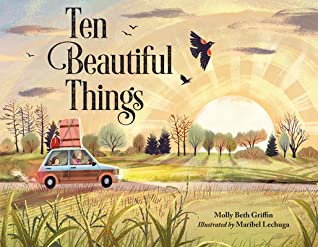
TEN BEAUTIFUL THINGS by Molly Beth Griffin & Maribel Lechuga - a book about feelings and appreciating the world


Why this book?

If my children were younger, this would definitely be a book I'd want to keep on our bookshelves to return to over and over again. As a person who is always looking for the small joys in life, I really connected with the idea of finding "ten beautiful things" in the world. This is a lovely story that shows us how looking for the positives and small joys in life can help with the anxiety and fear that comes with big changes -- or even with the ups and downs of everyday life.


My thoughts as a creator:

One of the things I enjoyed about this book was the way the author used all the senses for different perspectives on “beautiful things.” It was sweet the way Gram began choosing the things and then Lily joined in with her own ideas – which Gram accepted. The relationship between Gram and Lily showed love and care and respect. So much to love about this story!!

I also loved the sense of place all around them as they travelled, created by the lovely illustrations. I especially liked the way light and shadow added an additional level of realism to the computer-generated illustrations. It was wonderful to see that the body shapes of the characters were realistic and not idealized.


My thoughts as an educator:

I liked the thought-provoking distinction made between “pretty” and “beautiful.” This would be interesting to discuss with students, especially in light of the idea that beauty depends on the beholder.

It was wonderful to see that the body shapes of the characters were depicted realistically and not idealized. This book made me think about people in my own life I can rely on for support – another great subject for classroom discussion.


Ages: 5-9

Grades: Suitable for K - 5

Connections: life changes, feelings, positivity, small joys of life

Activities:

Writing: Have each student create their own list of ten beautiful things or create a class list of beautiful things. A class activity could be to create a calendar or classroom tree where each day, a different child records one “beautiful thing” they noticed that day.

Social-Emotional Learning: Discuss the difference between “pretty” and “beautiful”? What things make you feel beautiful inside? What things do you think are beautiful?  Have students draw a picture or make a mind map to show all the things that they think are beautiful.

Social-Emotional Learning Challenge: Have students think about and share  their responses with partner: How do you cope with difficult emotions or challenges? Use art materials of their choice to create their own “beautiful thing” that shows their feelings.

Outdoor Learning: Take students on a nature walk or a walk around the neighbourhood. Have them use their five senses to discover the world around them on the walk, for example, the smell of cut grass or the sound of boots crunching on snow. What beautiful things will did they find?


More resources:

Here’s an interview with author Molly Beth Griffin and book publisher Yolanda Scott.


Here's another take on this book by author Pat Zietlow Miller at Picture Book Builders: https://picturebookbuilders.com/2021/04/ten-beautiful-things-is-one-beautiful-book/


Summary from the publisher:

Lily and her grandmother search for ten beautiful things as they take a long car ride to Iowa and Lily's new home with Gran. At first, Lily sees nothing beautiful in the April slush and cloudy sky. Soon though, Lily can see beauty in unexpected places, from the smell of spring mud to a cloud shaped like a swan to a dilapidated barn. A furious rainstorm mirrors Lily's anxiety, but as it clears Lily discovers the tenth beautiful thing: Lily and Gran and their love for each other.

Ten Beautiful Things leaves the exact cause of Lily's move ambiguous, making it perfect for anyone helping a child navigate change, whether it be the loss of a parent, entering or leaving a foster home, or moving.

Ten Beautiful Things, written by Molly Beth Griffin and illustrated by Maribel Lechuga, was published by Charlesbridge in 2021.