Showing posts with label Learning from Picture Books. Show all posts

Friday, January 26, 2018

CINDERELLA AND THE FURRY SLIPPERS by Davide Cali & Raphaëlle Barbanègre

I love modified fairy tales, but what I love even more is when they have strong girls at the heart of the story.

A humorous take on a traditional fairytale with a strong female character and an engaging voice. Reviewed at That's Another Story by Andrea L Mack
Summary from the publisher:

Handsome princes, fancy castles, extravagant balls . . . in this girl-power fractured fairy tale, Cinderella learns that if it looks too good to be true, it probably is, and it’s better to create your own happy ending.

Cinderella is dying to go to the ball. She’s seen pictures of the fancy castle and the handsome prince, she’s heard the fairy tales about true love, she’s found the perfect dress in Princess magazine and she’s even found an ad for a Fairy Godmother. She’s all set.

Except the fairy godmother doesn’t look like the one in the ad. And the castle doesn’t look like the picture. And the prince . . . well, Cinderella decides her fairy-tale ending is going to look different–and be a whole lot more fun.

Cinderella and the Furry Slippers was written by Davide Cali and illustrated by Raphaëlle Barbanègre. It was published in 2017 by Tundra Books.

Opening:

Once upon a time there was a poor little girl named Cinderella who lived with a terrible stepmother and two even worse stepsisters.
She spent her days housecleaning while her awful stepmother and stepsisters had tea and cake.

My Thoughts as a Writer:

This humorous take on the traditional fairy tale shows a strong female character who makes her own decisions. The author has created an engaging voice for the story and provided us with a non-traditional ending that leaves some room for speculation.

My Thoughts as a Teacher:

This is a nice choice for showing students that princesses can be strong and make their own decisions—and maybe even try a different job.  It would be interesting to compare and contrast this with a traditional version of the story.

Ages: 4 - 7

Grades: PreK – Grade 2

Themes: princesses, fractured fairy tales, careers

Activities:

Discuss: What is your favorite page in the story? Why?

Draw/Write: What new job do you think Cinderella decided to try? Draw and write about it.

Draw or write a story to show what happens next!

Thursday, July 13, 2017

Learning from Picture Books – JABARI JUMPS by Gaia Cornwall

I loved this story! It’s a perfect summer read, since so many kids are facing their own swimming pool challenges at this time of year. When I read this book to my kindergarten students in June, they really enjoyed it!

Summary from the publisher:

Jabari is definitely ready to jump off the diving board. He’s finished his swimming lessons and passed his swim test, and he’s a great jumper, so he’s not scared at all. “Looks easy,” says Jabari, watching the other kids take their turns. But when his dad squeezes his hand, Jabari squeezes back. He needs to figure out what kind of special jump to do anyway, and he should probably do some stretches before climbing up onto the diving board. In a sweetly appealing tale of overcoming your fears, newcomer Gaia Cornwall captures a moment between a patient and encouraging father and a determined little boy you can’t help but root for.

Working up the courage to take a big, important leap is hard, but Jabari is almost absolutely ready to make a giant splash.

Jabari Jumps was written and illustrated by Gaia Cornwall. It was published in 2017 by Candlewick Press.

Opening:

“I’m jumping off the diving board today,” Jabari told his dad.

My Thoughts as a Writer:

This story has the kind of simple but perfect concept that many picture book writers are looking for. Most kids can relate to some kind of swimming challenge, whether putting their head under or jumping in, or, like Jabari, trying the diving board. I really loved how the author portrayed the relationship between Jabari and his dad. The support of Jabari’s family is with him, even when he’s making his own decisions.

I also loved the size of this book, the diversity of the characters and the subtle but playful use of different textures in the illustrations.

My Thoughts as a Teacher:

There's a lot of scope for lessons related to this book! I might have students make predictions about what will happen in the story, and talk about emotions and feelings based on Jabari’s actions and expressions. It would also be a great way to start a discussion about discussions about fears and strategies for coping with them, beginning with Jabari’s strategies of taking a deep breath or taking his time to think and be ready. 

Although this is probably not the intent, adults can learn a lot from this book too, in the way that Jabari’s dad calmly lets Jabari make his own decision about whether to jump or not.

Ages: 4 - 8

Grades: K - 3

Themes:  swimming, facing fears, bravery, family

Activities:

What challenges have you faced when learning something new? What did you do when you felt scared?

Think about something you are scared to try. Draw a picture to show how you might do it or write a list of steps to get past your fears.

Check out this interview with Gaia Cornwall about the book:


Thursday, January 5, 2017

Learning from Picture Books – BEAUTIFUL

I'm excited to start off 2017 with this wonderful picture book that promotes diversity and positive self-image. As a teacher and as a mother, I'm always looking for books that show children, and especially girls, of different shapes, sizes and abilities, as confident and multi-talented. I recommended this book to my local library to purchase for their collection.
Summary from the Publisher:

Every girl is unique, talented, and lovable. . . .Every girl is BEAUTIFUL.
Much more than how one looks on the outside, true beauty is found in conquering challenges, showing kindness, and spreading contagious laughter. Beautiful girls are empowered and smart and strong!

BEAUTIFUL breaks barriers by showing girls free to be themselves: splashing in mud, conducting science experiments, and reading books under a flashlight with friends. This book will encourage all girls to embrace who they are and realize their endless potential.

Beautiful was written by Stacy McAnulty and illustrated by Joanne Lew-Vriethoff. It was published in 2016 by Running Press Kids.

Opening:

“Beautiful girls…have the perfect look.”

My Thoughts as a Writer:

The text is simple, celebrating different aspects of beauty for girls. The illustrations are the key to developing the underlying message that beauty is found in many different ways – showing girls as adventurers, scientists, and creators. This is a good text for studying how the text and illustrations work together.

My Thoughts as a Teacher:

I love the message that all girls are beautiful no matter how they dress or act, and that girls can do anything. I’d love to read this to my class to see how they react to it. The illustrations include confident girls with different skin colors and body types. It’s a good book for promoting self-acceptance. Every child’s library should include this book.

Ages: 3 - 7

Grades: PreK - 2

Themes: self-acceptance, diversity, beauty, empowerment

Activities:

What does beautiful mean? Make a list of all the different ways of showing beauty.

Make a “beautiful” class book by having each student draw a picture of a friend (male or female) and write about what makes them beautiful.


Create a mirror template. Have each child draw a self-portrait inside the mirror that shows something awesome about themselves. Write an explanation or sentence about what makes them beautiful.

Friday, December 9, 2016

Learning from Picture Books – I Am Josephine (And I Am a Living Thing)

I've never seen a picture book that talks about this idea of classification before. A simple but unique story.

Summary from the Publisher:

Meet Josephine: a spirited and curious girl, a big sister, and a human being. She’s also a mammal, an animal, and a living thing—all identities she explores with readers in this simple informational picture book.

Josephine presents her family (and herself) as examples of human beings, and then familiar creatures like her dog and her mom (and herself) as mammals. Next, she adds whales, lobsters, hummingbirds, and elephants (and herself) as examples of animals. Finally, she shares examples of living things, including moose, foxes, butterflies, flowers, and bugs… and, of course, herself!

Inspired by science and nature writer Jan Thornhill’s many classroom visits, this book is intended to help children recognize themselves as part of the natural world, with an emphasis on how all living things share similarities.

Playful, kid-friendly illustrations in vibrant colors paired with minimal text make this an easy introduction to the classification of living things. Endmatter goes into further detail about the unique characteristics of humans, mammals, animals, and living things.

I am Josephine (and I am a living thing), was written by Jan Thornhill and illustrated by Jacqui Lee, was published in 2016 by OwlKids.

Opening:

“I am Josephine. I am Josephine, and I am a human being.”

My Thoughts as a Writer:

I really loved the concept of this book, and the simple kid-friendly text and illustrations. The repetitive style creates a rhythm and expectation for the reader. I also liked the places where readers are invited to find or count examples of each concept.

The illustrations are cartoon-like and fun, but also make it easy to identify each animal or being.

My Thoughts as a Teacher:

I haven’t seen a book that explains these categories to young children before and I really love it. I think it could provoke a lot of discussion. What is a living thing? I liked the lists at the end to explain the concepts.

Ages: 3 - 7

Grades: K - 2

Themes: living things, mammals, classification of animals

Activities:

Provide pictures of different kinds of living things for children and have them decide which group(s) they belong to.

Draw a picture of yourself and write your answer to the question on the last page of the book: What makes you different from other human beings?

Think about how you fit into other groups (e.g., immediate family group, relative group, friend group, class group, school group ) etc. and write an “I am ______ story of your own.

Thursday, September 1, 2016

Learning from Picture Books – A TIGER TAIL

The subtitle is: Or What Happened to Anya on Her First Day of School. This is a fun twist on a back-to-school story, with a classic message about how everyone is different.


From the creative mind of rising star Mike Boldt comes a hilarious and original tale about overcoming back-to-school jitters, making new friends, and taking things in stride.

Anya wakes up to discover that she has grown a tiger tail. Yes, a striped tiger tail. It also happens to be the first day of school. What will the other kids think? Are girls with tiger tails even allowed to go to school?!

Anya is about to find out.

A Tiger Tail was written and illustrated by Mike Boldt and published in 2016 by Simon & Schuster Books for Young Readers.

Opening:

“Anya woke one day, only to discover that overnight, she had grown a tiger tail.”

My Thoughts as a Writer:

I loved the opening sentence, which is stretched over two or three pages where in the illustration we see the tail, but Anya doesn’t yet. This really builds up the suspense, because readers will want to see how she reacts. I appreciated this different take on the typical first day of school story. Even though I had a strong sense of how the story might end, the way it came about still had an element of surprise.  A great example of how to take a “tried and true” theme or story and put a new spin on it.

I love Mike Boldt’s style (big and bold) because it’s so great for read alouds! I also like the design of the book and the way the illustrations extend across pages. I thought this style brought an “up close and personal” feel to the story.

My Thoughts as a Teacher:

I think this would be great way to introduce a discussion about going to school worries without drawing attention to anyone in the class (or introducing your own thoughts about what your students might be afraid of). Lingering on the last page would show students that everyone is different in some way.

Ages: 4 – 8 

Grades: prek - 2

Themes: first day of school, fears, individual differences, diversity

Activities:

Make a game by creating several cards with different animal parts on them. Take turns choosing a card and explaining why it would be useful to have that part.

Think of a time when you felt worried about being or looking different and write/draw a picture to tell about what happened. Share with a partner if you wish.

Read Imogene’s Antlers by David Small, for a book with a similar idea and different situations.


Thursday, August 11, 2016

Learning from Picture Books: FINDING WINNIE

Now that the library strike is over, I’ve lugged home a big armload of books. I finally have gotten around to reading this very special picture book, and it was worth waiting for!  
Summary from Amazon:

During World War I, Captain Harry Colebourn, a Canadian veterinarian on his way to serve with cavalry units in Europe, rescued a bear cub in White River, Ontario. He named the bear Winnie, after his hometown of Winnipeg, and he took the bear to war.

Harry Colebourn's real-life great-granddaughter Lindsay Mattick recounts their incredible journey, from a northern Canadian town to a convoy across the ocean to an army base in England . . . and finally to the London Zoo, where Winnie made a new friend: a boy named Christopher Robin.

Gentle yet haunting illustrations by acclaimed illustrator Sophie Blackall bring the wartime era to life, and are complemented by photographs and ephemera from the Colebourn family archives.

Finding Winnie: The True Story of the World’s Most Famous Bear was written by Lindsay Mattick and illustrated by Sophie Blackall. It was published in 2015 by HarperCollins.

Opening:

“Could you tell me a story?” asked Cole.

My thoughts as a writer:

There is so much to love about this story! The unique structure of intertwining stories from different generations is fascinating.  I loved learning about how Winnie the Pooh came to be, and enjoyed learning about in the White River connection, having driven through there many times on the way to Thunder Bay. I thought the author did a lovely job of integrating interesting facts (e.g., the number of ships sailing across the Atlantic) into the story.  This is truly a book for all ages – and I think it would be a lovely “family read aloud” to spark interesting discussions.

The realistic, soft style of the illustrations suited the historical nature of the text. It was so interesting to have reproductions of actual photographs  and research materials in the Scrapbook at the end.

My Thoughts as a Teacher:

As a teacher, I really liked the way this book contains a “story within a story” and explains how a story character developed and took inspiration from real life. There are many reviews and ideas posted about how to use this book with students, but I think it would be a lovely mentor text for encouraging students to learn about their own family history. For example, to encourage children to interview their own parents and grandparents to find out about the interesting stories in their family history.

Ages: ages 6 and up

Grades: upper elementary

Themes: bears, family history, soldiers, zoo, Christopher Robbins

Activities:

There is a wonderful and comprehensive teacher guide for Finding Winnie with  Social Studies, Math , Language Arts, Science and Arts connections.

Brain Pickings featured a summary of the story with links to resources.


Friday, June 10, 2016

Learning from Picture Books – WOLFIE THE BUNNY

At first this book seems like just another funny story (and it is) but there are also deeper layers and an important but subtle message about standing up for yourself and the people you love.

Summary from the publisher:

The Bunny family has adopted a wolf son, and daughter Dot is the only one who realizes Wolfie can--and might--eat them all up! Dot tries to get through to her parents, but they are too smitten to listen. A new brother takes getting used to, and when (in a twist of fate) it's Wolfie who's threatened, can Dot save the day?

Wolfie the Bunny was written by Ame Dyckman and illustrated by Zachariah OHora. It was published in2015 by Little Brown and Company.

Opening:

“The Bunny family came home to find a bundle outside their door.”

My thoughts as a writer:

This is a really great example of how illustrations work with the text to add more humor and layers to the story. The bright, bold illustration style without much background keeps the focus on the characters.

I really liked the use of repetition. A pattern is set up that seems like it’s going to be predictable but then there's a surprising twist.

My Thoughts as a Teacher:

There are a lot of possibilities for discussion with this book – how it might feel to have a new sibling, why the baby is getting so much attention, adoption, looking different than other people in your family, standing up for others. I really liked the idea that you can stand up for yourself and others, regardless of size.

Ages: 4 – 8

Grades: preschool - 2

Themes: individuality, getting a new sibling, family, standing up for others

Activities:

Draw your favorite page in the story. Explain why you liked it.

Make puppets and retell the story! This would be a really fun book to place at a retelling centre or to use in a retelling basket.

Thursday, May 12, 2016

Learning from Picture Books – SMALL SAUL

After reading The Most Magnificent Thing, I am a big fan of Ashley Spires, and this one is another great book to read in a classroom!

Summary from the publisher:


Ahoy there! Will this sweet little pirate find his place aboard The Rusty Squid or will he be forced to walk the plank?

When Small Saul joins the crew of The Rusty Squid, it doesn't take long for the other pirates to notice something is very different about this tiny fellow. He was born to sing sea shanties, bake pineapple upside down cakes and redecorate, not to hold a sword and plunder. Being rough and tough just isn't in his nature.

Small Saul learned at Pirate College that pirates only care about three things: their ship, being tough and lots and lots of treasure. Can Small Saul show these ruffians that despite his gentle spirit, he's worth his weight in gold? With treasure chests of laughs, 
Small Saul's high-seas adventure is a light-hearted celebration of individuality, perseverance and being true to one's self.

Small Saul was written and illustrated by Ashley Spires. It was published by Kids Can Press in 2011.

Opening:

“Small Saul loved the sea. He loved its vastness, its calmness, its blueness.”

My thoughts as a writer:

I really liked the opening of this book, especially with the dynamic angle that was chosen for the perspective of the first illustration. The introduction of Saul going to Pirate College was a lot of fun. There are lots of small details in the illustrations to add humor to the story.

My thoughts as a teacher:

The story is fun (always a great way to get kids to pay attention), but there are also some great opportunities for discussions about how it’s okay to be yourself and follow your own path. There is also a theme of perseverance in the way Saul tried different ways to fit in with the pirate crew.

Ages: 4 – 8

Grades: K - 3

Themes: individuality, perseverance, pirates, adventure

Activities:

What do you think pirates need to learn at Pirate College? Make a list.

Draw a treasure map and label it.

Make puppets and a pirate ship and act out the story of Small Saul.

The publisher also provided some ideas for using this book in the classroom.

What would you ask the author if you could? Here's an interview where she answers some student questions:


Thursday, March 31, 2016

Learning from Picture Books – WE’RE ALL FRIENDS HERE

This book shows that there is more than one side to a story and would be useful to discuss in a classroom. It’s one of the nominees for this year’s Blue Spruce Award from the Ontario Library Association. 


Sonny and Arthur have been thrown together since nursery school, but the two boys couldn't be more different. Sonny is careful and studious while Arthur is a whirlwind of mess and noise.

But when Arthur is not on the school bus one day, Sonny realizes it's pretty boring without his usual seatmate. Could it be true that the two boys are good for each other, even though they are so different?

With all the humour and silliness that appeals to readers of this age, the story is cleverly told in alternating perspectives — first from Sonny's point of view, and then from Arthur's — that will get kids thinking about putting themselves in someone else's shoes.

We’re All Friends Here, written by Nancy Wilcox Richards and illustrated by Tom Goldsmith was published by Scholastic Canada in 2014.

First line: “Arthur Leevy bugged me in nursery school.”

My thoughts as a writer:

Such an interesting story structure! It’s told by two different main characters in first person. First it starts with Sonny’s side of things, then we get Arthur’s perspective. The ending is told on two spreads, one from each character. I’ve never seen a picture book told in this way before. I’d be interested in reading it with students to see if they understand what is happening or need help from an adult.

I liked the way the illustrator included a lined paper drawing that looked like it was drawn by the character to start their section of the story. The realistic illustrations help to clarify which student is telling each part of the story.

My Thoughts as a Teacher:

This story would be useful for teaching about different perspectives and how, while everyone has their own point of view, one isn’t better or worse than the other. It would be good for starting discussions about listening to and thinking about other points of view.


Ages: 4 – 8

Grades: K - 3

Themes:, friends, different points of view, tolerance for others, empathy

Activities:

Do Arthur and Sonny like each other?  Explain.

Try comparing perspectives on the same event (e.g., going to an assembly, what happened a recess) with a partner, either by writing a paragraph or acting it out.

Another character, Debbie, is mentioned in the story. Write or draw a comic showing what things are like from her point of view.

Scholastic provides classroom activities

Thursday, March 24, 2016

Learning from Picture Books - SPECIAL DELIVERY

I am especially fond of stories about elephants and this one is a lot of fun! 


Sadie is on her way to deliver an elephant to her Great-Aunt Josephine, who lives completely alone and can really use the company.

She tries everything from mailing the elephant to boarding a plane, a train, and an alligator to get to her aunt's home. Along the way she meets an array of interesting characters, including an odd postal worker and a gang of bandit monkeys, who all help her get where she is going.

Special Delivery, written by Philip C. Stead and illustrated by Matthew Cordell was published by Roaring Brook Press in 2015.

First line: “Where are you going?”

My thoughts as a writer:

Although I predicted the ending, the journey to get there was a lot of fun. I really liked the way the author told the story completely in dialogue (and a few signs). This story also includes a wonderful example of effectively using a repeated line of text.

The illustrations are delightful, especially if you look closely at the expressions of the elephant and the clever details on each page. It was interesting that Sadie’s interactions with people in the story were all outside (outdoor post office) which made me think of Sadie’s story on another level as part of her imaginative play at a family gathering.

My thoughts as a teacher:

This story would be a lot of fun to read with young students! As a kindergarten teacher, I would probably plan to read it just for fun when setting up a class post office (even though snail mail seems to be disappearing). It would also be a good example for talking about story structure with a problem and solution. Or a good example for encouraging students to make up their own "tall tales."

Ages: 4 – 8

Grades: K - 3

Themes: voyages and travels, elephants, persistence

Activities:

Choose your favorite animal. Draw a picture to show an imaginative way to deliver your animal to Great-Aunt Josephine.

Act out the story, making up actions to show the different kinds of transportation Sadie used to get to Great-Aunt Josephine’s.


Play a group memory game: Sit in a circle. Pass around a bean bag or ball. Students repeat the line: On Sadie's trip to visit her aunt, she traveled by _______, adding a new method of transportation each time. See how many you can remember!

Extras:

To learn more about the author, illustrator and the process of making this book, visit Seven Impossible Things Before Breakfast for SPECIAL DELIVERY: A Visit with Matthew Cordell & Philip Stead and Even a Moment with Neal Porter


Thursday, March 17, 2016

Learning from Picture Books: HENRY HOLTON TAKES THE ICE

The illustrations in this book show lots of details about hockey and ice skating. This is another one of the picture books nominated for the Ontario Library Association's Blue Spruce Award. 


Henry Holton’s whole family is hockey mad.  Everyone, that is, except Henry.  When he holds a
hockey stick, Henry becomes a menace to the game—and an embarrassment to his sports-minded family.  It’s not until he sees his first ice dancing performance that Henry realizes there’s something he can do on the ice that doesn’t involve boarding and body checking.  Henry is ready to hang up his gear and try on some figure skates, but first he has to convince his hockey-obsessed family to let him follow his own path.

Henry Holton Takes the Ice, written by Sandra Bradley, illustrated by Sara Palacios and published by Dial Books for Young Readers in 2014.

First line: “Henry Holton’s dad played hockey. So did his mom, his grandfather, his uncle, all twenty-three of his cousins and his big sister, Sally.”

My thoughts as a writer:

The story follows a traditional plot where the main character is different than the other people close to him, and, after trying things their way, is eventually recognized for his own unique talents. I haven’t come across many other books about boys and figure-skating, so I think that’s a real hook to pull me into this story.

The illustrations are fun and contain interesting details, suggesting the illustrator spent a lot of time making observations at skating arenas! I wish there was more ethnic diversity in the scenes with groups of children on ice.

My thoughts as a teacher:

I really liked the message behind the story, since it opens the door to good discussion about “boy activities” vs. “girl activities” and not being limited by gender.  It was nice that Henry’s grandmother had an important role in the story.

Ages: 4 – 8

Grades: K - 3

Themes: individuality, ice skating, hockey, grandparents

Activities:

Henry’s grandmother surprised him when he found out about her past. Interview one of your older relatives to find out what sports or activities they liked to do when they were younger.

What are some other activities that people think are usually mostly done by girls? Boys? Draw a picture or write a story to showing a boy or girl doing an activity that might be surprising to some people.


For more great picture books, visit author Susanna Leonard Hill's original theme list of Perfect Picture Books on her blog or this theme list with links to Pinterest collections on each theme - a very helpful resource!

Thursday, February 25, 2016

Learning from Picture Books - LAST STOP ON MARKET STREET

I spent so much time thinking about this book as part of judging the Cybil finalists, I'm so glad I can finally share it!  This book has a unique voice and shows a side of life that I haven’t often seen in picture books. It won the Newbery Medal this year and also a Caldecott Honour for the illustrations!

Description from Amazon:

Every Sunday after church, CJ and his grandma ride the bus across town. But today, CJ wonders why they don't own a car like his friend Colby. Why doesn’t he have an iPod like the boys on the bus? How come they always have to get off in the dirty part of town? Each question is met with an encouraging answer from grandma, who helps him see the beauty—and fun—in their routine and the world around them.

Last Stop on Market Street was written by Matt de la Pena and illustrated by Christian Robinson. It was published by G. P. Putnam’s Sons, an imprint of Penguin Group, in 2015.

My Thoughts as a Writer:

I loved the way this story is told almost completely through a child's eyes, even though it is written in third person. The voice drew me in and made CJ's personality come alive. I think kids will really be able to relate to CJ. At the same time, the language and phrasing is poetic and creates interesting visual images in my mind, right from the beginning. The writing style is fresh and unique.
The bright, paint and collage illustration style reminded me of The Snowy Day by Ezra Jack Keats.

My Thoughts as a Teacher:

I enjoyed the way this book showed CJ in his real life, offering readers a glimpse of reality. CJ's many questions were great, showing his curiosity -- and could be the springboard for many discussions or to provide an intro for making a “wonder wall” in the classroom. 

I liked the message: “Sometimes when you’re surrounded by dirt…you’re a better witness for what’s beautiful.” This could be a great quote to discuss with students.

Themes: appreciation of life, grandmothers, bus rides, community

Ages: 5 – 10

Grades: Grades K to 5

Follow-Up Activities:

  • Use collage to create a piece of art that shows a scene you might experience on your way to school.
  • Have you ever been on a bus? Write a story or draw a picture to show what happens on a real (or invented) bus trip!
  • Talk about the setting. What details do you notice about CJ’s community from the illustrations and the story?
  • Listen to a piece of music with your eyes closed, like CJ did. What colours do you see? How do you feel?
To learn more about this book, check out this wonderful interview with Julie Danielson of Seven Impossible Things Before Breakfast -- Last Stop on Market Street: A Visit with Matt de la Pena & Christian Robinson.
 

Thursday, February 18, 2016

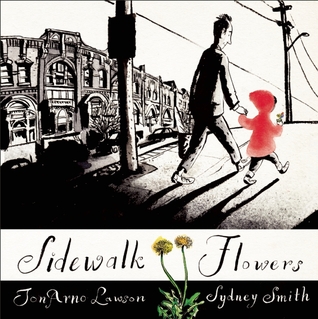
Learning from Picture Books: SIDEWALK FLOWERS

This beautiful wordless picture book is the winner of the 2015 Cybils Award in the Fiction Picture Book category! I am so proud to have been a part of the judging process to choose this lovely book as the winner. 

One of the things that surprised me the most about it was that even though it's a wordless book, there was a writer as well as an illustrator. In Canada, this book won a Governor General's Literary Award for Children's Illustrated Books 2015. It was also selected for the New York Times Best Illustrated Children's Books of the Year 2015.


In this wordless picture book, a little girl collects wildflowers while her distracted father pays her little attention. Each flower becomes a gift, and whether the gift is noticed or ignored, both giver and recipient are transformed by their encounter.

Written by award-winning poet JonArno Lawson and brought to life by illustrator Sydney Smith, Sidewalk Flowers is an ode to the importance of small things, small people and small gestures.

Sidewalk Flowers was published by Groundwood Books in 2015.


My Thoughts as a Writer:

I found it very interesting that even though this is a wordless book, a writer created the story. I loved the idea that to really appreciate this book, you need to stop and look, which is what the girl is doing in the story. A post from Groundwood explains how this book came to be and the author's role in the process. 

I really loved the simple, pen and ink drawing style and the effectiveness of the growing use of colour. I noticed the realistic expressions on the girl’s face, showing the pure pleasure she gets from finding and giving flowers. There is so much lovely detail in the illustrations, it is a book you can return to and explore again.


 My Thoughts as a Teacher:

Although this book may be more effective in a small group or one-on-one than in a class read aloud, I really liked the subtle encouragement to stop and notice, to give without expecting anything in return. Because it is wordless, this book is accessible to all sighted students, no matter what language they speak.

In sharing this with a group, I would probably “read” through the book by showing each page slowly, then go back and “re-read”, this time describing with students what is happening on each page.

Ages: 3 – 7

Grades: preschool and up

Themes: nature, kindness, giving,

Activities:

Create a black and white drawing showing a scene you walk past every day. Use a hint of colour to highlight something that people might not normally notice.

Compare what the girl and the father are looking at as they move through the story. Are there any changes as the story goes along? What do you think the author is trying to say? Does the story need words?

Choose your favorite page from the story. Explain why it’s your favorite.


For older students, it would be interesting to read and compare this book with The Man With the Violin by Kathy Stinson and Dusan Petricic. Where does the illustrator choose to add colour? Why?