Friday, November 4, 2011

Cool Blog Quote: Be Unpredictable

I'm always hoping to write a book that the reader just can't put down. James Scott Bell has some great tips in his post, What Makes a Novel a Page Turner? This quote sticks in my mind:

"...there is one thing your story absolutely cannot be, and that is predictable."
 
Think about that last section you wrote. Is it what your reader would expect? Maybe you need to change it up a little. Because if your writing is too predictable, chances are, you won't be creating that fresh, original work that agents and publishers are looking for.
 
Do you have any tips for how to keep from being too predictable in your writing?

Wednesday, November 2, 2011

Staying Focused on the Story

Even though I'm not officially participating in NaNoWriMo, I've been inspired by the many of you who are (including my crit buddy Christina Farley). So I've decided it's time I buckled down and got some serious writing done on my latest project.

One of the things that keeps me focused while I'm writing is to think about what I want the overall tone or feeling of the book to be. Is it a quiet, thoughtful book? Something scary? A funny, entertaining story? A gripping adventure? Thinking about the overall impression I want to make with my story helps me make choices about what I need to show the reader (and what can be summed up in a line or two).

What helps you stay focused on the story when you're writing?

Monday, October 31, 2011

Marvelous Middle Grade Monday: Half Brother

Today’s Pick: Half Brother by Kenneth Oppel

Published by HarperCollins, 2010


Summary:
Thirteen-year-old Ben is getting a new baby brother—a chimpanzee. Ben’s parents are both behavioral scientists and they want to prove that animals can learn American Sign Language. They think that raising a chimp in their home, like one of the family, is the best way to do it. If that wasn't hard enough, Ben has to deal with moving to a new city and a new school. Although it takes a while for Ben to warm up to his chimp brother Zan, over time they build a strong bond. At the same time, his father's research project experiences some issues and the conflict grows between Ben and his father. Eventually, Ben has to choose between loyalty to his family or to his brother. This story takes place in the early 1970's in Canada.

My Take:
This well-written novel really makes you think about the relationship between animals and humans. I admired the way research and information about the study of chimps is so skillfully blended into the story. With strong characters, bits of humor and lots of tension, this book was hard to put down. It kept me thinking long after I finished it. This story will appeal to both boys and girls, especially animal-lovers. The story isn’t only about the animal-human relationship, it’s about friendships, family and the love that brings living beings together (or keeps them apart). A note for fans of Kenneth Oppel's other books - this one is quite different, but still a compelling read.

Other Info:

This novel has been optioned for film.

Half Brother has won the Ontario Library Association's 2012 Red Maple Award. This reader's choice award is chosen by tens of thousands of grade 7 and 8 students across Ontario. This is Oppel's third win: Airborn and Skybreaker were previous recipients.
 
It has received several awards, including the 2011 Ruth and Sylvia Schwartz Book Award in the Middle Reader/Young Adult category, the Canadian Library Association Book of the Year Award and the Canadian Library Association Young Adult Book Award, and has been named as 2011 Best Book for Young Adults by the American Library Association.

Kenneth Oppel shares some of his thoughts about writing this novel on his blog in written form and in this clip as he accepts his awards.

 Other books by this author include:

Silverwing

Sunwing

Firewing

Darkwing

Airborn
Skybreaker
Starclimber

This Dark Endeavour (a new novel about the apprenticeship of Victor Frankenstein)

For more, go to Kenneth Oppel’s website.

Friday, October 28, 2011

Halloween Fun


Halloween has always been one of my favourite celebrations. It's hard not to get caught up in the enthusiasm of the kids. There's planning the costume, decorating of the yard to make it spooky, the traditional pumpkin carving, and of course, sorting and tasting all those yummy treats from the giant bag of loot.

For many kids, I bet Halloween ranks right up there with birthdays and Christmas as one of the year's best events. Strangely, I've never included Halloween in a story. When I think about how important it is to kids, now I want to. What kind of pumpkin face would your character make - scary or silly? How would they decorate - sweet smiling ghosts or a bloody murder scene? What costume would they wear? Would they collect treats or play pranks?

Have you ever included Halloween in a story?

P.S. The photo shows the pumpkins my daughters and I carved two years ago. Which pumpkin do you think I carved?

How is your writing going lately? Over at MiG Writers, we've posted a few of our tips for breaking a writing block.

Wednesday, October 26, 2011

What Else Do You Write?

Some of you might know that in addition to trying to write MG novels, from time to time I work on stories for young kids who are learning English.

Writing for kids learning English requires some different writing skills than working on a longer piece or a novel. I enjoy the challenge of trying to fit in a repeated phrase or language structure that readers can learn, while trying to make a very short but interesting story. I also learn little bits about the culture and life in Korea, even though I've never been there, because it affects what I can include in a story (places or sports kids are familiar with, activities they might do, etc).

Whenever I write one of these beginner reader stories, I always write too much and then have to pare it down to it's simplest form. It's a different way to work then when I write novels, which are often too sparse and seem to need to have more detail layered in. (Of course, then I often end up removing it again during revision round #27.)

What kinds of writing do you do? Does one kind of writing help you with another?

Monday, October 24, 2011

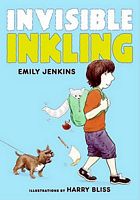
Marvelous Middle Grade Monday: Invisible Inkling

Today’s pick:  Invisible Inkling by Emily Jenkins

Published by Harper/Balzer & Bray, 2011

Back Cover Copy:

The thing about Hank's new friend Inkling is, he's invisible.
No, not imaginary. Inkling is an invisible bandapat, a creature native only to the Peruvian Woods of Mystery. (Or maybe it is the Ukrainian glaciers. Inkling hardly ever gets his stories straight.)

Now Inkling has found his way to Brooklyn and into Hank's laundry basket on his quest for squash—bandapats' favorite food. But Hank has bigger problems than helping Inkling fend off maniac doggies and search for yummy pumpkins: Bruno Gillicut is a lunch-stealing dirtbug caveperson and he's got to be stopped. And who better to help stand up to a bully than an invisible friend?

My Take:

What a fun story! This is an excellent example of a younger middle grade read (the publisher suggests ages 7 to 10), though I caught my 12-year-old sneaking a peak for a quick after school read. This book has a cool setting (the kid lives over an ice cream shop), a main character with a good sense of humour, and a creature with magical powers (an unusual invisible animal). I think it’s a great example of how to weave some issues that kids face (how to cope when a friend moves away, bullying) into an entertaining story.

Other Info:

A sequel, Invisible Inkling 2: Dangerous Pumpkins, is scheduled for publication in Summer 2012.

 Other books by this author include:
Toys Go Out, Being the Adventures of a Knowledgable Stingray, a Toughy Little Buffalo, and Someone Called Plastic (picture book)

What Happens on Wednesdays (picture book)
The Little Bit Scary People (picture book)

For more, go to Emily Jenkins’ website. 

Wednesday, October 19, 2011

Do You Need Backstory in Middle Grade Novels?

When you’re writing for middle grade readers, you need to keep the story moving. Backstory, or information about the background or history of characters and objects, can create an info dump that stops the action of the story, or at least slows it to a snail-like crawl.

Does that mean backstory is a no-no for middle grade novels?

I think you’d have a hard time finding a novel without any backstory at all. As middle grade writer Laura Pauling points out, we need backstory for helping to create characters with depth.
Knowing some background about a character can help develop a character’s motivation (e.g., Harry Potter’s backstory of surviving Voldemort’s attack as an infant). And knowing what a character has gone through in the past can sometimes help us feel more emotionally connected to characters. So the trick is to somehow include the backstory so that it doesn’t get in the way of the real here and now story of the novel.

Some strategies:

Weave it in gradually. This is the most common tip I see in articles about backstory. Avoid an info dump by giving key details about the character’s past in small pieces, rather than a long explanation.

Make sure it’s necessary. I think it’s so important to only include backstory where and when it’s needed.
Like other elements of your story, it has to be something that the reader really needs to know at that particular point in the story. Maybe it will keep the reader from being confused. Or maybe it shows why the character has made a decision. If it doesn’t have a purpose that helps move the story along, you might not need it. A lot of advice I’ve read (including Donald Maass) says not to include backstory at the beginning, when you’re trying to hook your reader.

Use only a little. Keep your backstory brief and to the point. (Remember, the Harry Potter novels, which at times seem to be built on backstory, are exceptions.)

Make it interesting or make it quick. If you are including some backstory and have found a natural place to bring it into your story, there are different ways to fold it in. You could just directly state it and quickly move on. Or you might bring it in through a brief memory, especially if you’re trying to develop an emotional connection to your reader. Flashbacks could be another way, but I don’t see those often in books for middle grade readers (they can be confusing).
Including backstory through dialogue is one way people try to avoid the “show not tell’ problem, but as author Elana Johnson says, this can be really awkward and unnatural sounding.

How much do you rely on backstory? Do you have any tips to share?

Links:
*As always, if you know of any great posts on backstory, please let me know in the comments and I’ll add them here for our reference.

Elana Johnson, author of the YA novel, Possession, has some thoughts on using backstory for world building.
Laura Pauling’s take on backstory.

Becca Puglisi of The Bookshelf Muse gives us some strategies for using backstory in this guest post at Sherry's Fiction Writing Tools.

At Writing While the Rice Boils, Debbie Maxwell Allen has a series of 4 posts by Randy Ingermanson that give us a thorough look at the topic of backstory.
Over at Literary Rambles, Casey McCormick posts a great tip on how much backstory to include from one of her blog readers, Carmen Ferreiro-Esteban.

Rachel Larow of Mommy Authors gives some tips on balancing backstory.

Literary Agent Rachelle Gardner gives advice on strategic ways to use backstory, especially in your novel opening.
Author Jody Hedlund weighs in on how much and when to use backstory.

At the Query Tracker blog, Stina Lindenblatt talks about backstory.

Author Mary Carroll Moore talks about how backstory can help or hinder.